Grease Trap Cleaning for Restaurants: The 2026 Guide to Compliance and Efficiency
Could a single overlooked maintenance task really lead to a massive fine or a total kitchen shutdown? It's a nightmare scenario that keeps every venue manager awake. You're already busy managing staff and food quality. The last thing you need is a foul odor driving away customers or a messy technician leaving residue across your kitchen floor. We know that grease trap cleaning for restaurants often feels like a disruption that happens at the worst possible time. It's stressful when you want to stay compliant with trade waste regulations but the rules feel like a moving target, right?
You deserve a kitchen that stays efficient and odor-free without the fear of a surprise inspection from the water authority. This 2026 guide from Fast Plumbing, LLC simplifies the entire process. We'll show you how to handle professional servicing while meeting the latest standards. You'll learn how to prevent costly backups and ensure your kitchen remains sanitary. We're going to solve the compliance puzzle so your operations stay FAST and hassle-free.
Key Takeaways
- Master the "1/4 Rule" and local trade waste requirements to stay compliant and avoid fines that can reach up to $10,000.
- Learn why professional grease trap cleaning for restaurants requires a full pump-out and baffle scraping to eliminate "rotten egg" odors for good.
- Identify the early warning signs of a grease trap emergency, like slow-draining sinks, before they lead to a total kitchen shutdown.
- Discover how a FAST response and a 1-minute callback guarantee can save your Friday night service from a plumbing disaster.
- Understand the importance of a "Clean-Up Like It Is Their Own" policy to ensure your kitchen remains sanitary and ready for customers.
What is a Restaurant Grease Trap and Why is it Critical?
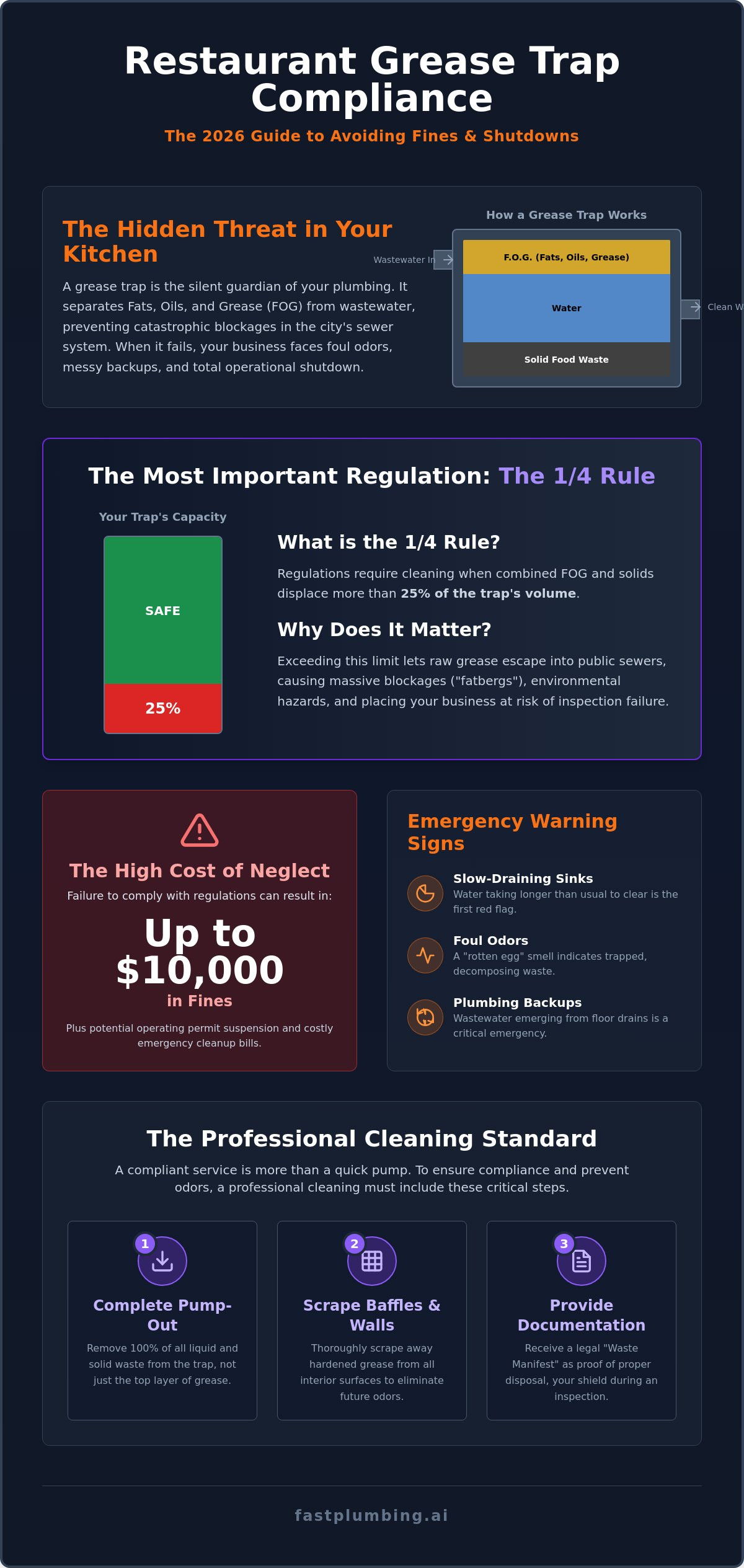
A Grease trap is essentially a security guard for your kitchen's plumbing. It's a specialized filtration device designed to intercept fats, oils, and grease—commonly known as FOG—before they reach the municipal sewer lines. When wastewater from your sinks and dishwashers enters the trap, the flow rate slows down significantly. This delay allows the water to cool. Since grease is lighter than water, it floats to the top and becomes trapped, while heavier food solids sink to the bottom. The clean water then escapes through an outlet pipe in the middle. It's a simple mechanism, but it's the only thing standing between your kitchen and a total plumbing collapse.
Without this system, your restaurant would face a total operational shutdown. A functional trap is the heart of a sanitary kitchen. It keeps your drains moving and your staff focused on the food rather than a puddle on the floor. When grease trap cleaning for restaurants is ignored, that "security guard" effectively goes on strike. The grease escapes, the pipes clog, and suddenly you have a backup in the middle of a dinner rush. The cost of failure is high. You aren't just looking at slow drains; you're risking full-scale sewer backups that can ruin your inventory and your reputation in minutes. We provide the expertise to ensure your system stays clear and your business stays open.
FOG: The Number One Enemy of Commercial Plumbing
FOG isn't just a byproduct; it's a destructive force. It includes animal fats, vegetable oils, and the heavy food solids that wash off plates. In its liquid state, FOG seems harmless. However, as it travels through cold pipes, it solidifies into massive, rock-hard obstructions called "fatbergs." These blockages don't just slow down your sinks; they can cause sewage to back up into your prep areas. This is why we often recommend professional drain cleaning as a vital secondary defense for your establishment. Keeping FOG out of your main lines is the best way to avoid an emergency call.
Grease Trap vs. Grease Interceptor
The main difference between these two is scale. A grease trap is usually a smaller, indoor unit located right under the three-compartment sink or floor drain. It's built for lower flow rates and manual cleaning. On the other hand, a grease interceptor is a high-capacity outdoor tank, often holding over 1,000 gallons. Larger restaurants or high-volume kitchens require these interceptors to handle the massive amount of waste they produce. While the mechanics are similar, interceptors require specialized equipment for a full pump-out. Whether you have a small trap or a massive interceptor, regular grease trap cleaning for restaurants is the only way to avoid a messy, expensive disaster. We make the process FAST and hassle-free so you can get back to business ASAP.
Regulatory Compliance and the 1/4 Rule
You can't manage what you don't measure. In the world of commercial kitchens, the "1/4 Rule" is the gold standard for staying out of trouble. It's not just a suggestion; it's a critical threshold that determines if your system is functioning or failing. Most local water authorities require that you pump your system before it reaches this point to protect the shared sewer infrastructure. If you're unsure where your levels currently sit, you can contact our commercial experts at Fast Plumbing, LLC to get a professional assessment and keep your kitchen running FAST and hassle-free.
Why is 25 percent the magic number? When fats, oils, and grease (FOG) along with settled solids occupy more than a quarter of the trap's capacity, the "retention time" drops significantly. The wastewater moves through the unit too quickly to cool down properly. This means the grease stays in a liquid state and shoots straight into the public sewer system. This untreated waste creates massive environmental hazards and puts your business in the crosshairs of trade waste inspectors. It's about protecting the community's water system as much as your own pipes, right?
Documentation is your shield during a surprise health or council inspection. Inspectors don't just look at your sinks; they look at your maintenance records. Keeping a meticulous pumping log or "waste manifest" is mandatory under your Trade Waste Agreement. You must use licensed haulers who provide proof of legal disposal at an approved facility. Failing to produce these records during an audit is an invitation for a massive fine and potential suspension of your operating permit.
How Often Should You Schedule Cleaning?
Your specific schedule depends on several variables that are unique to your operation. A high-volume bistro with a 50-gallon indoor trap needs much more frequent service than a small café. Consider these factors when setting your maintenance calendar:
- Menu Type: Fried foods and heavy proteins produce significantly more FOG.
- Seating Capacity: More customers mean more dishes and higher wastewater flow.
- Trap Size: Smaller units reach that 25 percent limit much faster than large outdoor interceptors.
The 1/4 Rule is the industry standard that requires grease trap cleaning for restaurants once the combined layer of FOG and solids reaches 25 percent of the trap's total liquid depth.
The Consequences of Non-Compliance
Ignoring grease trap cleaning for restaurants leads to more than just a bad smell in the kitchen. The financial and legal risks are substantial. You could face:
- Substantial Fines: Local authorities can issue heavy penalties for discharging grease into the public system.
- Business Closure: Health departments have the power to shut down your kitchen until the plumbing is brought up to code.
- Emergency Repair Costs: Clearing a main-line blockage caused by grease is far more expensive than routine pumping.
- Reputational Damage: Foul odors don't stay in the kitchen; they drift into the dining room, driving away customers ASAP.
Professional Grease Trap Cleaning Process
A quick skimming of the top layer isn't a cleaning. It's a shortcut that leads to disaster. True grease trap cleaning for restaurants involves a meticulous four-step process designed to reset your system to factory-fresh conditions. We don't just pull out the liquid; we evacuate every ounce of waste, from the floating grease to the heavy solids settled at the bottom. This full pump-out ensures that no "seed" grease remains to accelerate the next blockage. Our goal is to solve the problem before it starts, keeping your kitchen moving FAST and hassle-free.
Once the tank is empty, the real work begins. We scrape the walls and baffles to remove hardened grease that a vacuum hose simply can't reach. This step is vital because accumulated FOG becomes acidic over time. If left alone, this sludge eats through metal traps and causes structural failure. After the scraping, we perform a detailed inspection of the inlet and outlet T-pipes to ensure they aren't restricted. Finally, we apply professional-grade neutralizers to eliminate odors ASAP. We "Clean-Up Like It Is Our Own," so your staff can get back to work without dealing with a mess or a lingering stench, right?
Why Pumping Alone is Not Enough
Think of pumping as draining a bathtub but never scrubbing the ring around the edge. If you don't scrape the sides, that old grease stays behind. It acts as an anchor for new FOG to cling to, meaning your trap will reach the 1/4 limit much faster. More importantly, checking the baffles and pipes allows us to catch minor cracks before they become expensive leaks. A thorough cleaning is the best way to maintain the high commercial plumbing standards your restaurant requires to stay operational 24/7. Don't wait for a backup to find out your pipes are corroded.
Equipment Matters: Vacuum Trucks and Hydro Jetting
Efficiency depends on the right tools. We use industrial vacuum tankers that provide a fast, spill-free pump-out, even for high-capacity outdoor interceptors. These trucks are designed to handle the toughest solids without leaving a residue on your property. If we detect a restriction in the lines leading to or from the trap, we utilize hydro jetting to blast away blockages with high-pressure water. This combination of powerful suction and precision cleaning ensures your pipes are as clear as the day they were installed. You need a partner who brings professional-grade expertise to every job.
Signs of an Imminent Grease Trap Emergency
A grease trap failure doesn't happen in total silence. Your plumbing will give you warnings, but you have to be fast enough to catch them. Slow-draining sinks are usually the first red flag. When water takes longer to disappear, it's a clear signal that the FOG layer has restricted the flow. If you ignore this, the next sign is often a foul, "rotten egg" odor. This happens when anaerobic bacteria begin to grow in the stagnant grease layer. It’s a stomach-turning smell that can quickly drift into your dining room and drive away customers, right?
The situation becomes critical when you start seeing grease in the drainage lines or water backing up through the floor drains. This isn't just a mess; it's a biological hazard that requires an immediate halt to all kitchen operations. Seeing water pooling around your feet during a lunch rush is the ultimate nightmare. At this point, you don't just need a pump-out; you need a professional who can solve the blockage ASAP. We specialize in grease trap cleaning for restaurants that prevents these disasters from spiraling out of control.
Emergency Triage: What to Do Right Now
If your kitchen is currently flooding, stay calm but act with extreme urgency. Follow these three steps to protect your property:
- Stop the water: Shut down every sink and dishwasher immediately. Every gallon you pour down the drain will end up on your floor.
- Check the exterior: Look for overflows at the external interceptor in the car park or service area. This helps us determine if the blockage is in the main line.
- Call a pro: Reach out to an emergency plumber who offers a 1-minute callback guarantee.
We understand that a shutdown costs you money every minute. That’s why we prioritize speed and reliability to get you back in business fast and hassle-free. If you're in a crisis, call our emergency team now for an immediate response.
Preventing Future Overflows
Once the immediate crisis is solved, you need a plan to ensure it never happens again. Prevention is much cheaper than emergency repairs. Start by training your staff on a strict "dry-scrape" policy. No grease or heavy food solids should ever enter the sink. Installing high-quality sink strainers is another simple way to keep your trap from filling up with debris. Finally, the most effective tool is a consistent schedule. Regular plumbing maintenance and proactive grease trap cleaning for restaurants will keep your drains clear and your health inspector happy. We'll treat your kitchen like it's our own, ensuring every clean-up is thorough and professional.
Why Choose Fast Plumbing, LLC for Your Restaurant?
Why settle for a technician who leaves your kitchen smelling worse than when they arrived? Many service providers treat grease trap cleaning for restaurants as a "dirty job" that doesn't require a delicate touch. We disagree. At Fast Plumbing, LLC, we understand that your kitchen is your livelihood. We combine 29+ years of commercial plumbing expertise with a level of care that borders on the personal. We don't just pump and leave; we provide a complete solution that protects your business from the operational risks we've discussed throughout this guide.
Time is money in the food service industry. When your trap is reaching capacity or an inspection is looming, you don't have hours to wait for a return call. Our 1-minute callback guarantee is a firm promise that we value your time as much as you do. We respond with a military-like focus on punctuality because we know a plumbing delay is a revenue delay. It's about getting to your door fast and hassle-free, right? We solve the problem quickly so you can focus on your customers.
Let's talk about the "mess factor" that many competitors ignore. Standard pumping services often leave a residue or a lingering odor that makes your staff miserable. We follow a strict "Clean-Up Like It Is Our Own" policy. This means we don't just evacuate the waste; we ensure the work area is sanitary and presentable before we leave. You won't find messy footprints or greasy spills in our wake. We treat your property with absolute respect from the moment we arrive until the job is done.
Transparency is the foundation of our partnership. We offer flat-rate pricing for scheduled grease trap cleaning for restaurants. You'll know exactly what you're paying before the vacuum truck even arrives. This transparency allows you to budget for compliance without the fear of hidden fees or "emergency" upcharges for routine work. We believe in good, regular communication and no-nonsense service that keeps your kitchen running ASAP.
The Fast Plumbing, LLC Difference: Speed and Reliability
Our 24/7 availability isn't just a marketing slogan. It's a shield for your business operations. If a trap overflows during your busiest Saturday night shift, you need a team that can deploy immediately. We specialize in rapid intervention to solve the crisis before it reaches your dining room. Our no-nonsense approach means we identify the problem, fix it, and get out of your way. We protect your revenue by ensuring your kitchen stays open during peak hours.
Professionalism You Can Trust
We are fully licensed and insured to work in high-stakes commercial environments. With nearly three decades of industry experience, we’ve seen every possible configuration of grease trap cleaning for restaurants. We treat your property with absolute respect, ensuring that our presence never disrupts the professional atmosphere of your establishment. You can trust us to handle the technical details of compliance while you handle the cooking.
Get your grease trap serviced FAST—book now!
Secure Your Kitchen’s Future with Proactive Maintenance
Maintaining a high-volume kitchen is hard enough without worrying about sewer backups. You've learned that staying ahead of the 1/4 rule is the only way to avoid those $10,000 fines. Remember, true grease trap cleaning for restaurants involves deep scraping and baffle inspections; it's not just a quick surface pump. By spotting the signs of an emergency early, you protect your staff and your bottom line.
We are ready to support your business with 24/7 Emergency Commercial Support and our famous 1-Minute Callback Guarantee. You won't have to worry about a lingering mess because our Clean-Up Like It Is Their Own Guarantee ensures your kitchen remains spotless. We bring 29 years of expertise to your door, fast and hassle-free.
Get Your Grease Trap Cleaned FAST—Call Us Now!
Your kitchen deserves to run at peak efficiency every single day. Take the stress out of compliance and let us solve your plumbing puzzles ASAP.
Frequently Asked Questions
How often does a restaurant grease trap need to be cleaned?
Most establishments require professional servicing every 30 to 90 days. Your specific frequency depends on your menu type, seating capacity, and the size of your trap. High-volume kitchens that do a lot of frying will reach the 1/4 rule limit much faster than a small coffee shop. It's best to check your local municipal requirements to stay compliant and avoid surprise fines.
What is the "1/4 Rule" in grease trap maintenance?
The 1/4 rule is the industry standard that requires a full pump-out when the combined layer of fats, oils, grease, and solids reaches 25 percent of the trap's total liquid depth. Once you cross this threshold, the unit loses its ability to separate grease effectively. This leads to grease bypassing the trap and entering the public sewer, which can result in heavy penalties from local authorities.
Can I clean my restaurant grease trap myself to save money?
While you can technically clean small indoor traps manually, it is rarely worth the risk or the mess. Many jurisdictions now require a manifest from a licensed hauler to prove legal disposal of the waste. Professional grease trap cleaning for restaurants ensures the baffles are scraped and the waste is disposed of according to strict environmental laws. We handle the dirty work so your staff can focus on the food.
What happens if I forget to clean the grease trap?
Forgetting this task leads to slow drains, foul odors, and eventually a total sewage backup in your kitchen. Beyond the plumbing disaster, you face significant legal risks. Health departments can issue heavy fines or even suspend your food service license. In some cities, repeat violations for high grease discharge can lead to massive surcharges on your water bill or immediate business closure.
Why does my grease trap smell even after it has been cleaned?
Lingering smells usually mean the trap wasn't cleaned thoroughly or there is a venting issue. If a technician only pumps the liquid without scraping the hardened grease off the walls and baffles, that old sludge continues to rot. We use professional-grade neutralizers and a "Clean-Up Like It Is Our Own" policy to ensure your kitchen stays fresh and sanitary after every visit, right?
How much does professional grease trap cleaning cost?
Costs vary based on the size of your system and the frequency of your service. Small indoor traps are generally more affordable to maintain than large 1,000-gallon outdoor interceptors that require industrial vacuum tankers. We offer transparent, flat-rate pricing for scheduled maintenance to ensure there are no surprises on your bill. Contact us for a specific quote tailored to your kitchen's needs ASAP.
Is grease trap cleaning required by law for all food businesses?
Yes, grease trap cleaning for restaurants is a legal requirement for almost any establishment that prepares food. Municipalities enforce these laws to prevent "fatbergs" from destroying public sewer infrastructure. Even if you don't use a deep fryer, the fats from dairy and meats are enough to cause blockages. Staying compliant requires regular pumping and meticulous record-keeping for at least three years in most areas.
What do I do if my grease trap is overflowing right now?
Stop using all sinks and dishwashers immediately to prevent further flooding. Check your exterior interceptor for signs of a main line blockage and then call a professional for 24/7 emergency support. We offer a 1-minute callback guarantee to solve your crisis fast and hassle-free. Our team is trained to handle overflows with extreme urgency to get your kitchen back in business before the dinner rush.
