How to Prevent Plumbing Emergencies: The Ultimate Proactive Guide for 2026
What if the difference between a relaxing weekend and a $400-per-hour emergency repair was just ten minutes of your time? It's a nightmare to wake up to a flooded kitchen or a sewer backup that disrupts your entire life. You likely already feel the weight of rising service costs and the fear of sudden property damage. We understand that frustration. Nobody wants to see their hard-earned money drained by a crisis that could have been avoided.
This guide shows you exactly how to prevent plumbing emergencies using a proactive "detect and deflect" strategy. You will learn the specific maintenance steps and early warning signs needed to stop disasters before they flood your home or ruin your budget. We're covering everything from the latest 2026 smart leak detection trends to a "set it and forget it" routine that keeps your system running FAST and hassle-free. It's time to lower your water bills and get the peace of mind you deserve, right?
Key Takeaways
- Identify the "Silent Fail" phenomenon to catch tiny leaks before they turn into catastrophic bursts that threaten your property.
- Discover the "Drain-First" strategy and learn how to prevent plumbing emergencies by stopping major clogs before they ever enter your pipes.
- Protect your home's "Big Three" infrastructure components, including the simple maintenance step that prevents water heater tank explosions.
- Explore the 2026 smart home plumbing revolution and learn how modern leak detection technology stops water damage FAST, right?
- Recognize exactly when to put down the wrench and call a licensed Master Plumber to catch the hidden issues that DIY inspections miss.
What is a Plumbing Emergency and Why Do They Happen?
A plumbing emergency is any situation posing an immediate threat to your property’s safety, your family's health, or the structural integrity of your home. It’s more than just a leaky tap; it’s a burst pipe flooding your lounge or a sewer backup that creates a biological hazard. In modern plumbing systems, every component works together. When one part fails, the whole system is at risk. Understanding how to prevent plumbing emergencies starts with respecting the constant pressure your pipes endure every single day.
Most disasters begin with a "Silent Fail." This is the microscopic crack or the slow corrosion hidden behind your walls. According to local water authorities, a single leaking tap can waste over 10,000 litres of water annually. That’s a massive amount of water causing silent damage to your home’s foundation and significantly increasing your utility costs. There are three primary drivers behind these failures:
- High Water Pressure: Like high blood pressure for your house, it forces joints and valves to their breaking point until they eventually snap.
- Sediment Buildup: Minerals found in the local water supply settle in tanks and pipes, leading to internal rust and restricted flow.
- Aging Materials: Every material has a lifespan; pipes eventually become brittle and crack without warning as they reach their limit.
Thankfully, 90% of these crises are avoidable. Learning how to prevent plumbing emergencies through regular plumbing maintenance allows you to catch these stressors before they turn into a midnight catastrophe.
The High Cost of Being Reactive
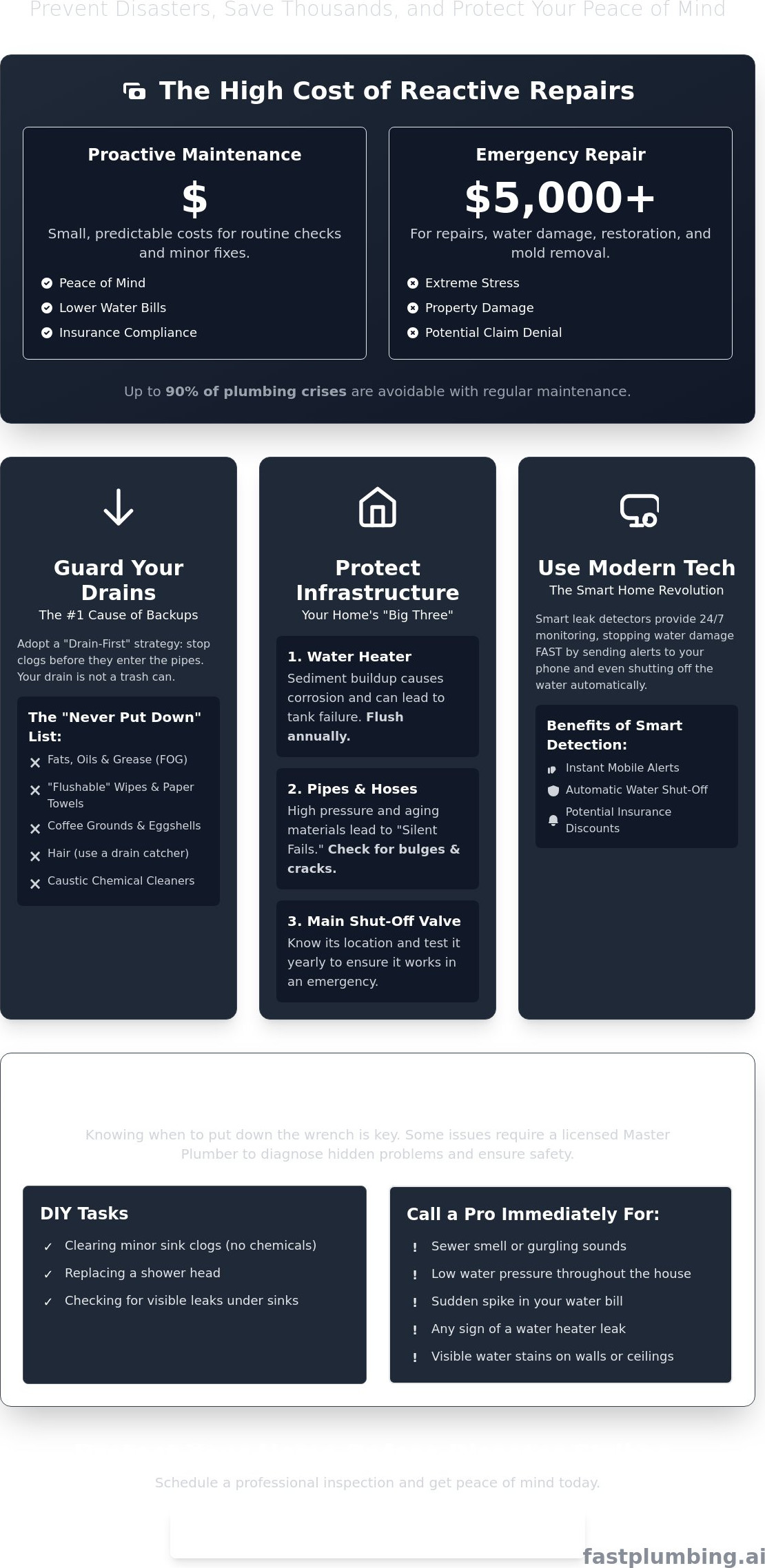
Waiting for a disaster to happen is a massive financial risk. In 2026, emergency call-out rates can be triple the standard hourly fee. You aren't just paying for the repair; you're paying for the restoration of ruined carpets, structural timber rot, and potential mold growth. These secondary damages often exceed $5,000 in total costs. Additionally, many insurance providers now look for evidence of proactive care. If they find a burst was caused by long-term neglect, they may reject your claim entirely.
The Stress Factor: Why Peace of Mind Matters
The emotional toll of a flooded home at midnight is exhausting. It disrupts your work, your sleep, and your family's safety. Proactive prevention is the best way to lower your blood pressure before a crisis starts. By staying ahead of repairs, you ensure your home remains a sanctuary rather than a source of anxiety. The "Prevention Mindset" is the most valuable tool a homeowner has to keep life running smoothly, right?
Guard Your Drains: Preventing the #1 Cause of Backups
Your drains are the most frequent source of household chaos. Most people treat them like a "black hole" where waste simply disappears. In reality, your pipes are a complex network that requires a "Drain-First" strategy. This means stopping the clog before it ever enters the pipe. If you want to know how to prevent plumbing emergencies, start by realizing that your drain is not a trash can. Items like coffee grounds, eggshells, and potato peels belong in the compost, not the disposal. These materials don't break down easily and will eventually settle in the "P-trap," causing a total blockage.
When a sink slows down, many homeowners reach for a bottle of caustic chemicals. Stop right there. These products are often too weak to clear a tough blockage but strong enough to eat through your metal or PVC pipes. Over time, they cause internal thinning and pinhole leaks. Investing in professional drain cleaning is the only way to restore your pipes without damaging them. Outside your home, stay alert for tree roots. They seek out the moisture in your sewer lines and can crack even the strongest pipes. If you notice multiple slow drains or gurgling sounds, it is time to schedule a camera inspection FAST before a total backup occurs.
The "Never Flush" List: Beyond the Basics
The label "flushable" is a marketing myth. These wipes do not disintegrate like toilet paper. Instead, they snag on pipe imperfections and create massive blockages that require professional removal. Another silent killer is FOG: Fats, Oils, and Grease. When you pour liquid grease down the sink, it cools and hardens into "fatbergs." These rock-like masses narrow your pipes until nothing can pass through. In the bathroom, hair is the primary culprit. It acts like a net, catching soap scum and skin cells until a solid plug forms inside your walls. It’s a mess that’s easy to avoid, right?
Kitchen and Bathroom Best Practices
Small habits make a huge difference in your home's health. Always follow the "Cold Water Rule" for your garbage disposal. Run cold water while the unit is on. This keeps grease solid so the blades can chop it into tiny pieces. Hot water melts grease, allowing it to coat your pipes further down the line where it eventually hardens. Install mesh strainers in every tub and shower. It’s a $5 fix for a $500 problem. Finally, perform a monthly flush. Pour a gallon of very hot water down your kitchen sink to clear minor soap and grease buildup before it has a chance to solidify. It’s simple, effective, and keeps your system running hassle-free.
Infrastructure Protection: Water Heaters, Pipes, and Gas Lines
Think of your home's infrastructure as its vital organs. You have the "Big Three": the water heater, the main water line, and the gas system. If one of these fails, the damage is rarely minor. Mastering the maintenance of these systems is the core of how to prevent plumbing emergencies. Most homeowners ignore their water heater until the hot water stops, but by then, it might be too late. Inside your tank sits a sacrificial anode rod. Its only job is to corrode so your tank doesn't. If you don't replace this rod every few years, the tank itself begins to rust. This leads to pinhole leaks or, in extreme cases, a tank explosion.
Another hidden danger is thermal expansion. In a closed plumbing system, water expands as it heats up. Without an expansion tank to absorb this extra volume, the pressure can spike and blow out your T&P valve or damage your fixtures. If you notice your faucets dripping only when the water heater is running, you likely have a pressure issue. You can find more details on these warning signs in our guide to water heater repair. Addressing these small pressure shifts now keeps your home safe and your system running FAST.
Water Heater Longevity Secrets
Sediment is a silent killer for water heaters. Over time, minerals settle at the bottom of the tank and create an insulating layer. This forces the burner to work harder, which eventually cracks the tank's glass lining. Flush your tank annually to remove this buildup. You should also test the Temperature and Pressure (T&P) relief valve twice a year. Just lift the lever and ensure water flows out. If it doesn't, the valve is stuck, and your safety is at risk. Watch for "rusty" water or popping noises; these are clear signals that internal corrosion is already taking hold. It is a simple check that guarantees your peace of mind, right?
Pipe Health and Gas Line Safety
Burst pipes are a classic winter nightmare. Prevent this by insulating exposed pipes in crawlspaces or basements before the first freeze. A simple foam sleeve can save you thousands in restoration costs. Gas safety is even more critical. If you ever smell "rotten eggs," leave the house immediately and call for a professional gas line repair. Never ignore a faint sulfur scent. Visual inspections are your best defense. Walk through your basement once a month. Look for corrosion on joints or damp spots on the floor. Catching a small drip today means you won't have to deal with a flooded home tomorrow.
Modern Detection: Using Tech to Stop Leaks FAST
In 2026, you don't have to wait for a ceiling to collapse to know you have a leak. The "Smart Home Plumbing" revolution has changed the game. Tech that used to be reserved for pros is now available to every homeowner. This is a massive shift in how to prevent plumbing emergencies. Instead of relying on your eyes and ears, you can use digital sentinels to watch your pipes 24/7. These systems catch the "Silent Fails" we discussed earlier before they become disasters. You get an alert, you solve the problem, and you move on with your day. It’s that simple.
A high water bill is often your first digital warning sign. If your usage spikes but your habits haven't changed, you have a leak. Don't ignore it. It could be a slab leak or a pinhole in the wall. Modern leak detection technology can pinpoint these hidden threats FAST. This tech isn't just about finding water. It's about monitoring "pipe fatigue" caused by fluctuating pressure. When you track your usage digitally, you see the problems before they see you.
How to Set Up a Smart Leak Detection System
Setting up your defense is a straightforward four-step process. First, install Wi-Fi-enabled sensors near high-risk areas like your water heater, dishwasher, and washing machine. Second, connect these sensors to a central hub that sends instant smartphone alerts. Third, consider installing an automatic shut-off valve. This device kills the water main the moment a leak is detected, saving your home from thousands in damage. Finally, calibrate the system. You want it to know the difference between a long shower and a burst pipe so you don't get false alarms. It’s a smart investment that pays for itself the first time it stops a flood, right?
Manual Pressure Monitoring
You can also keep it simple with manual checks. High water pressure is a leading cause of joint failure. Use a basic $10 pressure gauge on your outdoor hose bib once a month. The "Safe Zone" for most homes is between 40 and 60 PSI. Anything higher than 80 PSI puts your appliances and pipes at risk of sudden failure. If your pressure is consistently high, you need a Pressure Reducing Valve (PRV) installation. This simple device protects your entire home from the stress of municipal water surges. If you’re ready to upgrade your home’s defense, contact our team today to install a professional PRV or a smart shut-off system and keep your home protected.
The Professional Partnership: When to Call Fast Plumbing, LLC
DIY maintenance builds a strong foundation for your home's health. However, even the most dedicated homeowner has limits when it comes to complex systems. Truly mastering how to prevent plumbing emergencies involves knowing when to step back and let a licensed Master Plumber take over. We call this the "Professional Eye." It is the ability to spot a hairline fracture in a manifold or the specific type of corrosion on a gas fitting that looks normal to an untrained observer. A pro doesn't just look for what is broken; they look for the weak points that will fail under next month’s pressure. This foresight is what keeps your property dry and your budget intact.
If you have recently moved into a property or live in a home older than 15 years, a "Plumbing Audit" is essential. This is a deep-dive into your infrastructure to ensure your system meets the latest 2026 standards. Sometimes, despite your best efforts, a crisis can still occur. In those moments, check our emergency plumber guide to ensure you hire a qualified expert under pressure. Solving a small issue today with Fast Plumbing, LLC is always cheaper than a midnight rescue tomorrow.
What a Professional Inspection Includes
A professional visit uses technology that goes beyond a standard toolkit. We perform video camera inspections to travel deep into your sewer lines, locating tiny root intrusions before they cause a total backup. We also stress-test your emergency shut-off valves. Many homeowners discover their main valve is "frozen" only when a pipe bursts and they can't stop the flow. That is a nightmare you want to avoid, right? For business owners, we provide specialized commercial plumbing checks. High-traffic facilities face unique pressures that residential systems don't, and a single hour of downtime can cost thousands in lost revenue.
Fast Plumbing, LLC: Your 24/7 Safety Net
We pride ourselves on being the reliable neighbor with professional-grade expertise. Our "1-minute callback guarantee" ensures you aren't left waiting when you have an urgent concern. We value your time as much as our own, which is why our service is designed to be FAST and hassle-free. When we enter your home, we follow our "Clean-Up Like It’s Our Own" promise. You shouldn't have to deal with a mess after a job is completed. Don't wait for a small drip to become a flood. Schedule your 2026 Plumbing Wellness Audit today! and let Fast Plumbing, LLC provide the protection your home deserves.
Secure Your Home’s Future with a Proactive Plan
You now have a complete strategy to safeguard your property from the unexpected. By combining the "Drain-First" approach with modern detection technology and regular infrastructure checks, you've significantly reduced your risk of a household crisis. Mastering how to prevent plumbing emergencies is simply about making small, disciplined choices today to avoid the massive financial and emotional toll of a system failure tomorrow. You’ve moved from being reactive to being in total control of your home’s health.
Fast Plumbing, LLC is here to serve as your reliable neighbor and professional partner. With over 29 years of Master Plumber experience and our industry-leading 1-minute callback guarantee, we provide the expert oversight needed to keep your system running at peak performance. Whether you require our 24/7 emergency availability or a comprehensive wellness audit, we promise to treat your home with absolute respect and clean up like it’s our own. You deserve the peace of mind that comes with a protected home, right?
Protect your home—Get a FAST plumbing inspection now!
Frequently Asked Questions
How often should I have a professional plumbing inspection?
You should schedule a professional inspection at least once every year. For homes older than 15 years or properties with large trees near the sewer line, a check-up every six months is even better. These visits allow a pro to catch the tiny drips and joint weaknesses that homeowners often miss, ensuring your system stays reliable and hassle-free, right?
Can high water pressure really damage my pipes?
Yes, excessive water pressure is one of the leading causes of sudden pipe failure. Think of it as high blood pressure for your home. Anything consistently over 80 PSI shreds internal gaskets and puts immense stress on your pipe joints. Using a simple gauge to monitor this protects your appliances and prevents expensive bursts FAST.
What is the most common cause of a plumbing emergency?
Blocked drains and sewer backups are the most frequent crises we see. These disasters usually happen because of long-term buildup from grease, hair, or foreign objects. Understanding how to prevent plumbing emergencies starts with being mindful of what goes down your drains and scheduling routine cleanings to keep the lines clear and open.
Are "flushable" wipes actually safe for my sewer line?
No, "flushable" wipes are a marketing myth and are not safe for your plumbing. Unlike toilet paper, these wipes do not disintegrate in water. They snag on pipe imperfections and bind with grease to create massive blockages. To keep your system running without a hitch, only flush human waste and standard toilet paper.
How do I find my main water shut-off valve?
Your main shut-off valve is typically located near the water meter or where the main line enters your home. Check your basement, crawlspace, or look for a concrete box near the street. Once you find it, label it with a bright tag so every family member can locate it FAST during a crisis. Test it twice a year to ensure it isn't stuck.
What should I do if I suspect a hidden water leak?
Turn off all water fixtures in your home and check your water meter immediately. If the dial is still moving, you have an active leak somewhere in your system. You should also watch your monthly water bills for any unexplained spikes. If you suspect a leak, call for professional leak detection to solve the problem before it causes structural rot.
How can I prevent my pipes from freezing in the winter?
Insulate exposed pipes in unheated areas and let your faucets drip slightly during extreme cold snaps. Open cabinet doors under sinks to allow warm house air to circulate around the plumbing. These small habits are a vital part of how to prevent plumbing emergencies when temperatures drop below freezing, protecting your home from the chaos of a burst pipe.
Is a tankless water heater less likely to cause an emergency?
A tankless unit eliminates the risk of a massive 50-gallon tank flood, but it still requires regular care. While you won't have to worry about a rusted-out bottom, these units can still suffer from mineral scaling. Annual descaling is necessary to keep the system efficient and prevent the heating elements from failing prematurely. It is a safer bet for your home, right?
