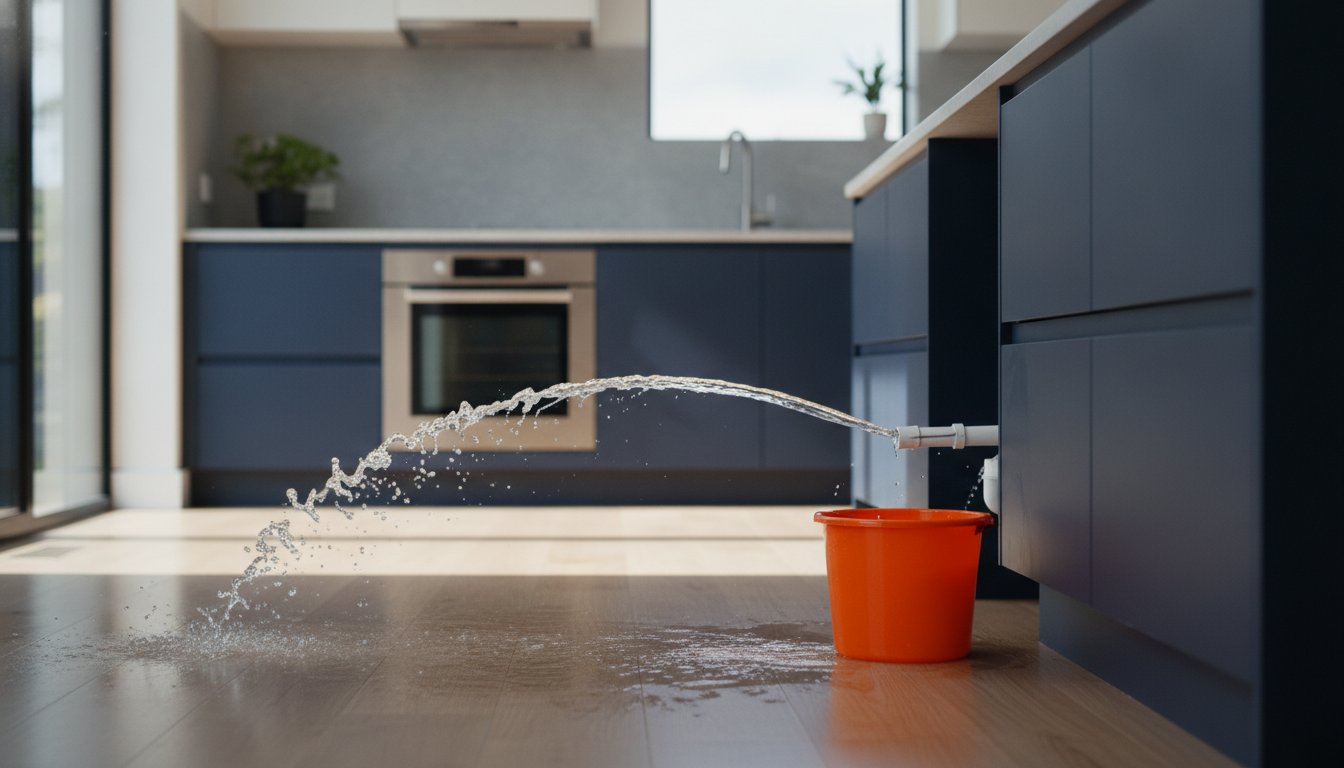
Leaking Pipe Water Damage: FAST Emergency Guide
Water damage is a race against time where the first 60 minutes determine the final cost of your home's survival. You're likely staring at a growing puddle or a soaked ceiling right now, feeling that pit in your stomach. It's natural to worry about structural rot, hidden mold, or the nightmare of a denied insurance claim. You need to act FAST to protect your property and your wallet. We have seen how quickly a small leak can turn into a major crisis, and we are here to help you take control of the situation right now.
Knowing exactly what to do for water damage from leaking pipe emergencies can save you thousands of dollars in restoration costs. We understand the intense pressure you're under. This guide provides the exact, high-speed steps you need to stop the water flow immediately, document the damage for your insurer, and get your home back to normal. We will walk you through the immediate emergency response, the latest 2026 insurance claim requirements, and the professional drying techniques that prevent long-term disaster. You can handle this crisis, and it starts with these simple, decisive actions.
Key Takeaways
- Shut off your main water valve and isolate electricity immediately to stop active damage in its tracks.
- Learn exactly what to do for water damage from leaking pipe situations, including the specific documentation needed for a successful insurance claim.
- Discover why high-velocity air movers and professional extraction tools are far more effective than standard fans at preventing mold growth.
- Identify the critical warning signs of concealed leaks behind walls or under slabs that require expert leak detection to solve.
- Master the high-speed restoration steps that minimize your repair costs and get your home back to normal FAST.
Stop the Flow: Immediate Steps for Water Damage Control
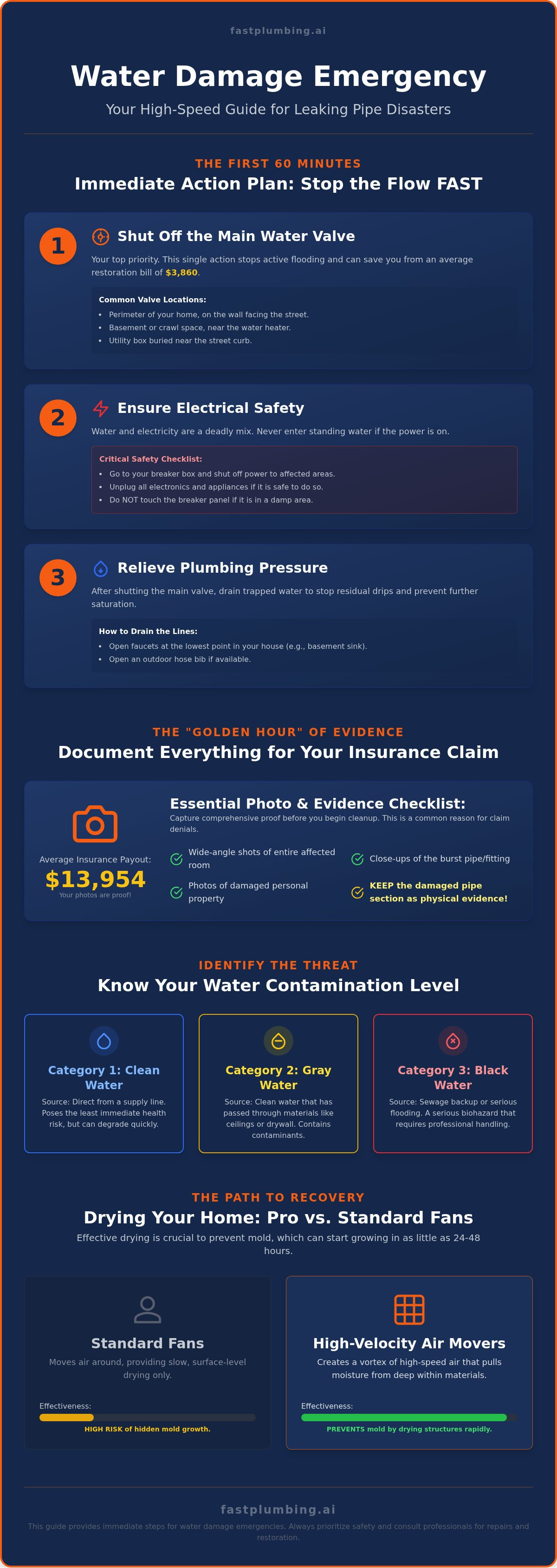
The moment you spot a leak, you are in a high-stakes race against the clock. Every second that water gushes from a burst pipe is another dollar added to your restoration bill. If you are currently wondering what to do for water damage from leaking pipe emergencies, your first priority is the main water shut-off valve. Do not waste time looking for the specific leak yet. Cut the water at the source to stop the active flooding immediately. This single action can be the difference between a simple patch job and a $3,860 national average restoration bill.
Locating Your Main Shut-Off Valve FAST
You need to find the valve now, not ten minutes from now. Start by checking the perimeter of your home, typically on the wall facing the street. This is where the main line enters your property. If you have a basement or crawl space, the valve is often located there, near the water heater or the front foundation wall. In some homes, it might be in a plastic box buried in the ground near the curb. Once you find it, turn it clockwise until it stops. If the valve is stuck, do not force it with a wrench; call for help immediately. Pro-tip: Once this crisis is over, mark the valve with bright neon tape so you can find it in the dark next time, right?
Electrical Safety Precautions
Water and electricity are a deadly combination. Never step into a room with standing water if the power is still on. If the leak is near outlets or appliances, go straight to your breaker box and shut off the power to those specific zones. If the main panel is in a damp area, do not touch it; wait for a professional.
- Unplug all electronics in the splash zone if it is safe to reach them.
- Move smaller appliances to a dry, elevated surface immediately.
- Avoid touching any metal fixtures or pipes while the power is still active in the room.
After the water is off and the area is safe, you must relieve the remaining pressure in your plumbing system. Open the faucets at the lowest point of your house, such as a basement laundry tub or an outdoor hose bib. This drains the "trapped" water out of the pipes and away from the leak site. A solid foundation in understanding water damage shows that the longer water sits, the deeper it penetrates your floors and walls, leading to structural rot. By draining the lines, you stop the slow drip that continues even after the main valve is closed.
Once you have stabilized the situation, you need an expert on-site to identify the exact cause and prevent a recurrence. You need an emergency plumber to arrive ASAP to handle the mechanical failure while you focus on saving your belongings. We pride ourselves on a 1-minute callback guarantee because we know that in a flood, every sixty seconds counts toward your home's survival. We will get to your door fast and hassle-free, treating your home with the same respect we would our own.
Assessing the Damage: Hidden Threats and Insurance Documentation
You have stabilized the emergency. Now, you must document the scene before you move a single rug or mop a single drop. Insurance adjusters look for clear evidence, and a lack of photos is a common reason for claim denials. Knowing what to do for water damage from leaking pipe disasters means capturing the "Golden Hour" of evidence. This is the period right after the leak is stopped but before the cleanup begins. Since the average insurance payout for a water damage claim is $13,954, every photo you take could be worth thousands of dollars.
The Essential Photo Checklist for Claims
Grab your phone and start recording. You need a comprehensive visual record to prove the extent of the loss to your provider.
- Take wide-angle shots of the entire affected room to show the scale of the flooding.
- Capture close-up photos of the specific burst pipe or failed fitting.
- Keep the damaged section of the pipe as physical evidence; do not throw it away!
- Photograph damaged personal property, focusing on serial numbers and brand names of electronics.
While you document the scene, you must identify the "Category" of water you are dealing with. A standard pipe leak is usually Category 1, or "Clean Water," which poses the least risk. However, if that water has passed through a ceiling or floor, it can quickly become Category 2 "Gray Water." If you are dealing with a backup, you might face Category 3 "Black Water," which is a serious biohazard. Following immediate steps for water damage safety is vital. Never touch or breathe in contaminated water without professional-grade protection.
Detecting Hidden Moisture
The most dangerous water is the water you cannot see. A "Concealed Leak" is a slow pipe failure hidden behind drywall or under floorboards. These leaks often go unnoticed until they cause structural rot or mold. Look for peeling paint, warped baseboards, or a faint, musty odor. These are red flags that moisture is trapped where it doesn't belong. Don't assume a wall is dry just because the surface feels okay, right?
Professionals use advanced tools like infrared thermal imaging and non-invasive moisture meters to "see" through your walls. These tools detect temperature differences caused by moisture, allowing for precise leak detection without tearing your house apart. If you suspect a hidden threat, our team can provide fast and hassle-free assessments to find every drop of trapped water before mold takes root. We treat your home like it's our own, ensuring no hidden threat is left behind.
Drying Out Your Home: Effective Water Mitigation Strategies
Once you have documented the scene, you must get the water out immediately. Stagnant water is your home's worst enemy. If you're wondering what to do for water damage from leaking pipe disasters, the answer is simple: move fast. Every hour that water sits increases the risk of structural failure and deep-seated rot. Start by extracting standing water. A heavy-duty wet/dry vacuum works for small puddles, but a submersible pump is necessary for deep flooding. We focus on rapid extraction to lower the humidity in your home before secondary damage begins.
Don't rely on your household ceiling fans or standard floor fans. They simply don't have the power to move enough air. You need high-velocity air movers to force moisture out of porous materials like wood and drywall. Pair these with industrial-grade dehumidifiers to pull moisture directly from the air. This process is a critical part of successful water damage insurance claims, as adjusters want to see that you took professional steps to mitigate the loss. If you don't show active mitigation, your claim could be at risk, right?
Drying Drywall and Insulation
Drywall acts like a sponge, pulling water upward through capillary action. To save your walls, you must remove the baseboards immediately. This allows air to reach the wall cavity behind the board. If the water rose higher than a few inches, we often recommend a "flood cut." This involves removing the bottom 12 to 24 inches of drywall to expose the studs and accelerate drying. You must replace wet fiberglass insulation because it loses its insulating properties and becomes a hidden breeding ground for mold once it's saturated.
Rescuing Hardwood and Carpet
Hardwood floors are beautiful but highly sensitive to moisture. When they get wet, they can "cup," which means the edges of the boards lift higher than the center. Professionals use specialized floor mat systems that vacuum moisture directly out of the wood grain to prevent permanent warping. For carpeted areas, you must pull up the carpet and the padding. The padding almost always needs to be replaced, but the subfloor underneath must be bone-dry before you even think about relaying the carpet. Time is your biggest threat here. Mold begins to grow within 24 to 48 hours, and once it starts, the cleanup becomes much more expensive.
Preventing this nightmare from happening again is just as important as the current cleanup. Once your home is dry and the repairs are finished, follow a consistent plumbing maintenance schedule. Regular checks of your supply lines and shut-off valves can catch small drips before they turn into a full-scale flood. We pride ourselves on being the reliable neighbor who gets to your door fast and hassle-free, ensuring your home stays dry and safe for years to come.
Repairing the Source: Fixing Leaking Pipes and Damaged Surfaces
Your home is finally dry, but the root cause of the chaos still needs a permanent solution. Deciding what to do for water damage from leaking pipe incidents usually involves a critical choice: do you settle for a localized patch or invest in a full section replacement? A quick patch might stop the immediate drip, but if your pipes are aging or corroded, you are likely just waiting for the next disaster. We evaluate the integrity of your entire system to ensure a one-time fix that lasts. Understanding how plumbing repair costs fit into your budget is essential before you commit to a major overhaul.
Secondary damage is often more expensive than the pipe repair itself. We look for rotted wall studs, compromised subflooring, and early signs of mold that may have developed during the leak. If your home has high water pressure or outdated galvanized steel lines, a systemic issue might be at play. We don't just fix the leak. We solve the problem that caused it, right?
Common Pipe Repair Techniques
For modern homes, we often use PEX piping and slip couplings for lightning-fast repairs. PEX is flexible, resistant to scale buildup, and snaked through walls with minimal demolition. However, if your home has recurring leaks in multiple rooms, a full "re-pipe" is often more cost-effective than constant emergency service calls. Every repair we perform meets or exceeds current national plumbing codes to guarantee your safety and insurance compliance.
Restoring Wall and Floor Finishes
Before you seal your walls back up, you must apply professional antimicrobial treatments to the studs and subfloor. This prevents "ghost mold" from growing behind your new drywall. We wait until moisture levels return to the industry "dry standard" before sanding or refinishing any hardwood. This precision prevents the wood from buckling later. Our goal is a seamless, hassle-free finish where you can't even tell a leak ever happened. We treat your property with a level of respect that borders on the personal, cleaning up like it's our own home.
Don't let a small leak turn into a structural nightmare. If you need a reliable neighbor with professional expertise, contact our expert team today for a fast and effective solution.
Professional Recovery: When to Call the Experts
Sometimes, a towel and a wrench simply aren't enough to save your home. If the leak is buried deep behind a drywall partition or under a concrete slab, you are facing a major structural threat. These "concealed leaks" require professional leak detection equipment to locate without destroying your property in the process. If you're currently staring at a damp spot and wondering what to do for water damage from leaking pipe issues that you can't physically see, the answer is always to call a professional. Any saturated area larger than 10 square feet is also beyond the scope of a DIY cleanup. Large-scale flooding requires industrial-grade moisture extraction to prevent permanent structural rot and mold colonies.
You must never attempt to handle "Black Water" on your own. If your pipe failure involves sewage or heavily contaminated groundwater, the health risks are extreme. Exposure to the bacteria and pathogens found in Category 3 water can lead to serious respiratory illness or infection. Professionals have the specialized safety gear and hospital-grade antimicrobial agents needed to sanitize your space properly. We prioritize your family's safety by handling these biohazards with a military-like focus on protocol. We don't just dry the area; we make it safe to breathe again.
The Value of 24/7 Emergency Plumbing
Waiting until the next business day is a gamble you will likely lose. Water doesn't punch a clock. A midnight leak can easily triple your restoration costs by sunrise if left to soak. The longer moisture sits, the deeper it travels into your foundation and wall framing. That is why we offer a 1-minute callback guarantee. In a flood, FAST service isn't a luxury. It is the only way to save your property and your sanity. We provide the immediate, authoritative response you need to lower your blood pressure and solve the crisis before it grows into a total loss.
Why Fast Plumbing is the Logical Choice
We bring over 29 years of experience to every high-stakes leak scenario. We aren't a distant corporate entity; we are your reliable neighbor with professional-grade expertise and a focus on punctuality. Our transparent, flat-rate pricing ensures you won't face any "emergency" surprises when the job is done. We pride ourselves on good, regular communication and a level of respect for your property that borders on the personal. Our "Clean-Up Like It's Their Own" policy ensures your home is left spotless and dry, right?
Get expert leak repair to your door—fast and hassle-free.
Secure Your Home and Save Your Sanity Today
You've moved through the high-stakes minutes of an emergency. You now know that stopping the flow and documenting the scene are the most critical steps in what to do for water damage from leaking pipe disasters. You've learned how to dry your home effectively and when a simple patch is not enough for long-term safety. Now, it's time to finish the job correctly. Don't let the fear of mold or structural rot keep you up at night. We bring 29+ years of industry expertise to every high-stakes scenario we solve.
With our 1-minute callback guarantee, you won't be left waiting while your floors soak. We promise a clean-up like it's our own, ensuring your home returns to its original state fast and hassle-free. You don't have to face this crisis alone when expert help is just a moment away. Take the final step to protect your property and your wallet right now.
Stop the damage NOW—Call Fast Plumbing for 24/7 Emergency Leak Repair!
You can handle this crisis with absolute confidence. We are ready to help you every step of the way to a full recovery.
Frequently Asked Questions
Is water damage from a leaking pipe covered by homeowners insurance?
Most policies cover damage that is "sudden and accidental," such as a burst pipe or a failed water heater connection. Coverage usually excludes gradual leaks caused by years of neglect or poor maintenance. In 2026, insurance companies are scrutinizing claims more closely, so you must document the scene immediately with photos to prove the failure was unexpected. In Florida, you have exactly one year from the date of the loss to file your initial claim.
How long does it take for mold to grow after a pipe leak?
Mold begins to grow within 24 to 48 hours of moisture exposure. This incredibly short window is why we emphasize a 1-minute callback guarantee and rapid response. If you are currently deciding what to do for water damage from leaking pipe emergencies, you must start the drying process ASAP. Waiting even one extra day can turn a simple drying job into an expensive mold remediation project.
Can I stay in my house while water damage is being repaired?
You can typically stay in your home if the damage is localized to a single room and there is no sewage contamination. However, professional restoration involves industrial air movers and dehumidifiers that are very loud and must run 24/7. if the leak affects your only bathroom or the kitchen, staying might be a major hassle. If mold has already started to grow, we often recommend staying elsewhere to avoid respiratory irritation.
How do I know if a leaking pipe has caused structural damage?
Look for sagging ceilings, warped baseboards, or floorboards that feel "spongy" when you step on them. These are clear signs that water has penetrated the structural framing or subfloor of your home. We use non-invasive thermal imaging to see through your walls and identify rot before it becomes a safety hazard. If your drywall feels soft to the touch, the internal structure is likely already compromised.
What is the average cost to dry out a room after a leak?
Industry data for 2026 shows the national average for water damage restoration is $3,860, with most homeowners paying between $1,383 and $6,370. These costs vary based on the category of water and how much drywall or flooring needs to be removed. Acting FAST to stop the leak and extract standing water is the best way to keep your restoration bill toward the lower end of that range.
Should I use a fan or a dehumidifier for water damage?
You must use both to properly protect your home. A high-velocity air mover pulls moisture out of porous materials like wood and drywall. A dehumidifier then pulls that moisture out of the air so it doesn't settle back into your furniture or ceiling. Using a fan without a dehumidifier just moves wet air around the room, which doesn't actually solve the problem, right?
What is the difference between a plumber and a water restoration expert?
A plumber is the specialist who stops the leak and repairs the mechanical failure in your pipes. A restoration expert handles the aftermath, including water extraction, structural drying, and sanitization. You need a plumber to arrive first to kill the water source. Once the pipe is fixed, the restoration team ensures that hidden moisture doesn't lead to long-term rot or mold growth.
What happens if I don’t dry out a leaking wall properly?
Trapped moisture will trigger "ghost mold" and wood rot inside the wall cavity where you can't see it. Over time, this weakens the studs and can lead to structural failure or persistent health issues for your family. Knowing what to do for water damage from leaking pipe failures means ensuring every inch of the wall is bone-dry before you ever think about hanging new drywall or applying paint.
