Restaurant Plumber Checklist: Maintaining Your Commercial Kitchen in 2026
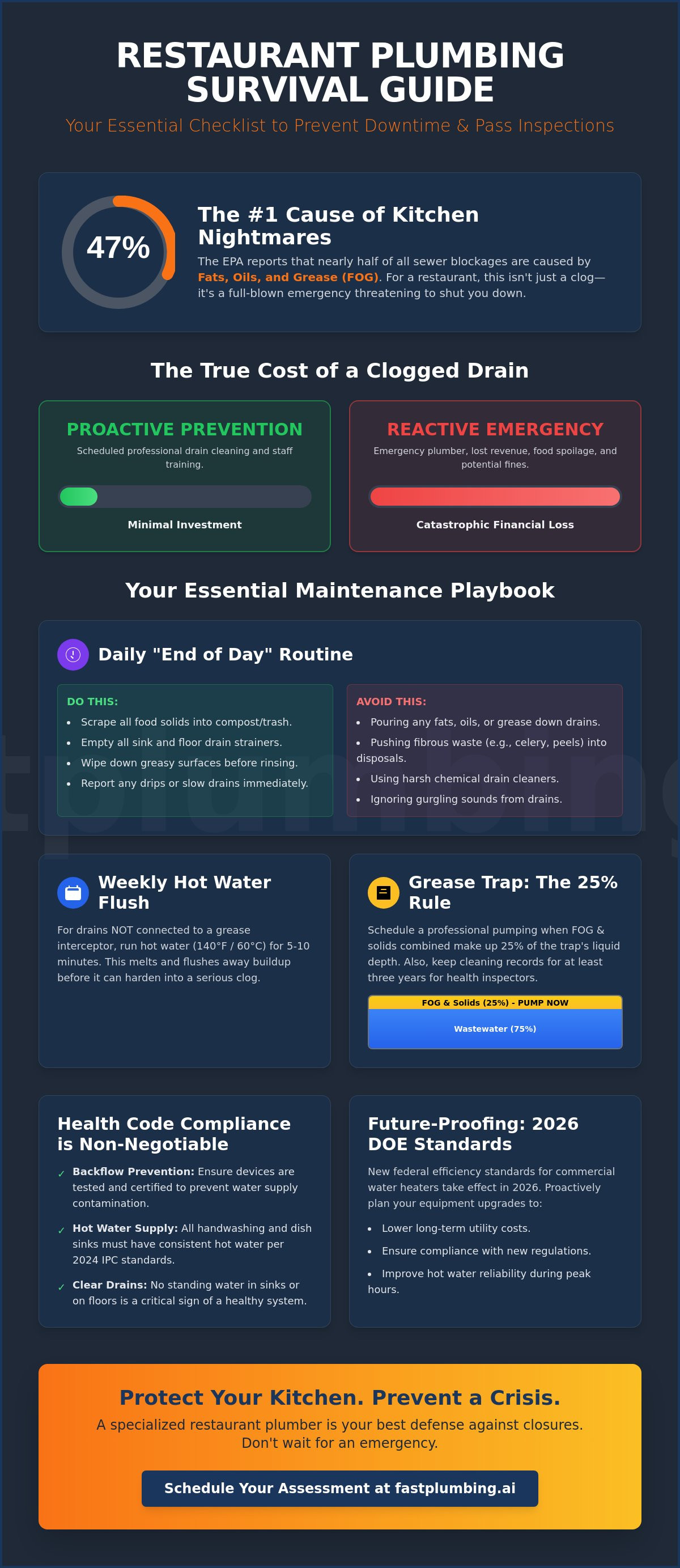
Did you know that the EPA attributes 47% of all sewer blockages to fats, oils, and grease? For a busy kitchen, a single backed-up floor drain isn't just a mess. It's a full-blown financial emergency that can shut your doors right before the Saturday night rush. You need a restaurant plumber who understands that every minute of downtime is a minute of lost revenue. You work too hard to let a preventable clog or a failed health inspection wipe out your profit for the week, right?
We agree that your focus should be on the food and the guests, not the floor drains. That's why we've created this comprehensive 2026 maintenance checklist. It's designed to help you master your facility’s plumbing and stay ahead of the new DOE efficiency standards for commercial water heaters. You'll learn how to prevent foul odors, manage your grease records for the required three years, and implement smart technology to stop leaks before they start. Here's exactly how to keep your kitchen fast, clean, and fully compliant all year long.
Key Takeaways
- Learn why a specialized restaurant plumber is your best defense against health code violations and sudden kitchen closures.
- Discover the essential "daily close" routines that protect your prep sinks and keep your dish station moving during peak hours.
- Master the 25% rule for grease trap maintenance to ensure long-term compliance and prevent foul odors in your dining area.
- Understand how the 2026 federal standards for commercial water heaters affect your equipment choices and utility costs.
- Identify the specific qualities to look for in an emergency partner who guarantees fast response times and a spotless cleanup.
The Restaurant Plumber Checklist: Why Specialized Service is Non-Negotiable
A residential sink handles a few gallons of water a day. Your commercial kitchen handles thousands of gallons while fighting a constant battle against fats, oils, and grease (FOG). This is why a standard handyman won't cut it. You need a specialized restaurant plumber who understands high-volume, high-fat systems. These professionals don't just clear clogs; they manage complex infrastructure designed to keep a business running under extreme pressure. Commercial fixtures are built differently than the ones in your home. They use heavy-duty materials to withstand boiling water, high-pressure sprayers, and industrial detergents. Without an expert who knows these specific components, a small leak can quickly turn into a catastrophic failure.
Think about the last time you saw a floor drain start to gurgle. In a home, it's an inconvenience. In a restaurant, it's a ticking clock. If that drain overflows, your entire operation stops. A professional restaurant plumber focuses on these high-stakes environments to ensure your pipes can handle the peak hour rush without a hitch. They have the specialized tools, like high-pressure hydro jetting equipment, to scrub pipes clean rather than just punching a hole through a blockage. It's the difference between a temporary fix and a reliable system, right?
Health Code Compliance and Safety Standards
Plumbing health is the foundation of your legal right to operate. Health inspectors prioritize water safety and drainage above almost everything else. They specifically look for proper backflow prevention devices to ensure wastewater never contaminates your potable water supply. If a Grease trap fails or a floor drain backs up, it creates an immediate sanitary hazard. Inspectors don't give "fix-it" tickets for sewage on the floor; they shut your doors instantly. You must also ensure every handwashing station is fully functional with consistent hot water to meet the latest 2024 IPC standards. Keeping these systems in top shape isn't just about safety. It's about staying open for business.
The Financial Cost of Kitchen Downtime
A single night of closed service can cost a busy restaurant thousands in lost revenue. You still have to pay your staff, and you might lose a fortune in perishable inventory if your water heaters fail. This is where the value of a pro shows up. Investing in scheduled professional drain cleaning prevents these expensive "surprises" from happening during your busiest shifts. It's much cheaper to maintain a pipe than to replace one during an emergency on a Saturday night. Preventative maintenance ROI is the total revenue you protect by avoiding closures, minus the cost of the service. In the restaurant world, that return is always high because it guarantees you never have to turn a customer away due to a plumbing crisis.
Essential Daily and Weekly Plumbing Maintenance for Commercial Kitchens
Closing time is the most critical hour for your plumbing. It's the moment when tired staff might take shortcuts that lead to expensive 3:00 AM calls to a restaurant plumber. You need to establish a "daily close" checklist that protects your infrastructure from the start. The rules are simple: no fats, oils, or grease (FOG) ever go down the drain. Fibrous waste like onion skins, potato peels, and celery stalks should also stay out of your garbage disposals. These items tangle around blades and create dense clogs that stop service during your busiest shifts. Catching these habits early is the only way to protect your revenue, right?
Small leaks are another priority. A tiny drip under a prep sink might seem minor, but it can quickly rot floorboards or create a slip hazard for your team. Train your staff to report even the smallest damp spots immediately. When you catch a leak early, the repair is usually fast and affordable. If you wait until it's a flood, you're looking at significant downtime and property damage. Staying proactive keeps your kitchen running FAST and hassle-free.
Drain Management: Sinks, Floor Drains, and Dishwashers
Your floor sink baskets and sink strainers are your first line of defense. Empty them every single night. If food particles sit in these baskets, they break down and slip through the mesh, eventually narrowing your pipes. For lines that aren't connected to your grease trap, perform a weekly "hot water flush." Running high-temperature water for five minutes helps melt away residual residue before it hardens. If you notice water swirling slowly or bubbles popping up in the sink, it's a clear sign of a developing blockage. These symptoms often require a commercial plumber to clear the line before it completely stops your dish station. Ignoring a slow drain today guarantees a flood tomorrow.
Fixture Inspections: Faucets, Sprayers, and Ice Machines
Leaking pre-rinse sprayers are silent profit killers. A small drip can waste hundreds of gallons of heated water every month, spiking your utility bills. Check these sprayers daily for cracked hoses or loose connections. You should also inspect your ice machine drain lines weekly. These lines are prone to "slime" or biofilm buildup, which can cause backups and health code violations. According to the FDA Food Code, maintaining proper sanitation in these drainage systems is mandatory for food safety. Finally, verify that your faucets reach the required temperature for handwashing and sanitation. If your water isn't getting hot enough, a quick leak detection or water heater check from a professional restaurant plumber can solve the problem before the health inspector arrives.
Managing Grease Traps and Interceptors for Long-Term Compliance
Grease is the natural enemy of your plumbing system. A grease trap works by slowing down the flow of warm, greasy water, allowing it to cool. As it cools, the fats, oils, and grease (FOG) float to the top while solids sink to the bottom. This process leaves a "clear zone" of water in the middle that can safely exit to the municipal sewer. If you let that grease layer get too thick, it escapes into the main lines. This leads to massive blockages that often require expensive sewer line repair down the road. You want to avoid that headache at all costs, right?
Compliance isn't just about avoiding clogs; it's about following the law. Most municipalities enforce the "25% Rule." This means your trap must be pumped before the grease and solids occupy 25% of its total capacity. If you exceed this limit, you aren't just risking a backup. You're risking heavy environmental penalties and municipal fines. A professional restaurant plumber ensures your system stays within these legal limits so you can focus on your guests instead of your pipes. It's the best way to prevent costly plumbing disasters that can tarnish your reputation overnight.
Signs Your Grease Trap Needs Immediate Attention
Don't wait for a total backup to call for help. Foul odors in your dining area or kitchen are the first warning signs that grease is decomposing and needs to be removed. You might also notice that sinks across your entire kitchen line are draining slowly at the same time. If you hear "gurgling" sounds coming from your floor drains during heavy use, your trap is likely full. These signs mean your system is struggling to breathe. Call a restaurant plumber FAST to clear the trap before it overflows into your prep area.
Scheduling Professional Maintenance and Record-Keeping
Staff should never attempt to clean a large interceptor themselves. It's a dangerous, messy job that requires specialized vacuum equipment and proper disposal manifests. For clarity, an indoor trap is usually a small unit under the sink, while an outdoor interceptor is a massive tank buried underground. Both require professional attention to function correctly. You must also keep a detailed "grease log" for municipal inspectors. Federal regulations require you to keep these pumping records for at least three years. Having these documents ready makes health inspections a breeze. It proves you're a responsible operator who takes facility health seriously. We'll handle the dirty work so you can keep your kitchen running FAST and hassle-free.
Commercial Gas Lines and Hot Water Systems: The Backbone of Your Service
Your kitchen can't function without heat. While drainage keeps the floors clean, gas and hot water keep the food cooking and the dishes sanitized. The demand placed on a restaurant's hot water system is staggering compared to a typical home. You're likely running hundreds of gallons of 140-degree water through your dish machine every single hour. This high-intensity use requires a restaurant plumber who understands the mechanics of high-capacity systems. If your water temperature drops even a few degrees below health department requirements, your entire operation is at risk of being shut down. It's a high-stakes game where equipment failure isn't an option, right?
Gas systems are equally demanding. Commercial appliances require massive BTU loads to maintain consistent cooking temperatures across a 12-burner range or a high-speed conveyor oven. When things go wrong, a standard gas line repair for a restaurant is significantly more complex than a residential fix. A specialist must ensure that gas pressure remains stable even when every appliance in the house is firing at once. If the pressure fluctuates, your cook times become unpredictable, and your food quality suffers. We're here to solve these technical hurdles so your chefs can focus on the menu.
Gas Line Safety and Appliance Hookups
Safety is the top priority when dealing with high-pressure gas. During your weekly deep cleans, always check the flexible gas connectors behind your equipment. These lines can become kinked or frayed when heavy ranges are moved for floor scrubbing. If you ever detect the "rotten egg" smell of mercaptan, you must evacuate the area and call a professional immediately. Proper ventilation and precise gas pressure are also essential for safety and cooking consistency. A restaurant plumber can verify that your regulators are sized correctly for your specific appliance lineup, ensuring a FAST and safe environment for your staff.
High-Capacity Hot Water: Ensuring Continuous Supply
To meet the 2026 DOE standards, new commercial gas storage water heaters must now reach 95% thermal efficiency. This often means transitioning to condensing technology, which requires specialized drainage for acidic condensate. You also need high-functioning mixing valves. These devices are critical; they allow you to store water at high temperatures to kill bacteria while delivering it to faucets at a safe level to prevent staff burns. For large venues, we recommend hot water redundancy. Installing two smaller units in tandem rather than one giant tank ensures that if one fails, you stay open. Regular sediment flushing is also non-negotiable to extend the lifespan of these expensive units. Contact us today to optimize your hot water system and avoid a cold-water catastrophe.
Finding Your 24/7 Restaurant Plumber: Speed, Reliability, and Cleanliness
When your main line backs up at 7:00 PM on a Friday, "fast" takes on a whole new meaning. You don't need a generic service provider who might show up by morning. You need a dedicated restaurant plumber who understands that every second of a leak is a dollar lost. True speed means having a partner with over 29 years of master plumbing experience ready to tackle high-pressure commercial rigs. This level of expertise ensures the job is done right the first time, preventing a repeat of the same crisis next week. You want a partner who values your time as much as you do, right?
Transparency is another non-negotiable factor. Emergency repairs shouldn't come with mystery invoices that blow your monthly budget. Understanding plumbing repair costs before the work begins allows you to make informed decisions for your facility. We prioritize clear communication and predictable pricing so there are no surprises when the bill arrives. This professional approach lowers your stress and lets you get back to managing your team and serving your guests.
The 1-Minute Callback: Why Response Time is Everything
A delayed response can turn a small drip into a catastrophic flood that ruins your flooring and inventory. While other companies leave you on hold or send you to an automated voicemail, we prioritize immediate contact. Our 1-minute callback guarantee is a promise that we are already moving toward a solution the moment you reach out. This level of urgency is essential for high-volume kitchens where a single hour of closure can cost thousands in lost revenue. Having a 24/7 dedicated commercial line gives you the peace of mind that a pro is always just a phone call away. We get to your door FAST and hassle-free.
Professional Clean-Up: Leaving Your Kitchen Service-Ready
Your kitchen must remain a sterile environment, even during a plumbing repair. A true professional respects the "Clean-Up Like It’s Their Own" philosophy. This means using boot covers and protective mats to ensure no outside contaminants enter your prep areas. If you're dealing with a sewage backup, thorough sanitization is mandatory to meet health code standards. We don't just fix the pipe; we ensure the entire work area is scrubbed and ready for your next shift. You won't have to spend hours cleaning up after us. We take pride in leaving your facility in better shape than we found it, ensuring you stay compliant and ready for service. Call us now to experience the difference that a disciplined, no-nonsense partner makes for your business.
Keep Your Kitchen Running FAST and Fully Compliant
Running a successful kitchen is a race against time and regulations. You now have the tools to stay ahead of the curve. By following a strict maintenance checklist, you protect your revenue and your hard-earned reputation. You know that managing grease traps and maintaining high-capacity hot water systems isn't just about plumbing. It's about business survival, right? A single failed inspection can stop your momentum. A proactive approach keeps your doors open and your guests happy.
When the unexpected happens, don't settle for a generic service provider. You need a restaurant plumber with the expertise to handle high-BTU gas lines and complex drainage rigs. With 29+ years of commercial experience and a 24/7 emergency response team, we're ready to solve your problems before they impact your shift. We offer a 1-minute callback guarantee because we know every second counts in a crisis. We value your property and guarantee a clean-up that leaves your kitchen service-ready.
Need a restaurant plumber ASAP? Get your 1-minute callback now!
Stay focused on your menu and your guests. We'll handle the pipes and keep your operations fast and hassle-free.
Frequently Asked Questions
What is the most common plumbing problem in restaurants?
Blockages caused by Fats, Oils, and Grease (FOG) are the most frequent issue. These substances solidify in your pipes and create dense obstructions that slow down your service. You can prevent this by training staff to scrape plates thoroughly before washing. If a clog does happen, you need a specialized restaurant plumber to clear the line FAST with hydro jetting rather than just using a standard snake.
How often should a restaurant grease trap be cleaned?
You must clean your grease trap before it reaches 25% of its total capacity. This is known as the 25% Rule and is a legal requirement in most jurisdictions. Depending on your kitchen's volume, this usually means pumping every 30 to 90 days. Keeping a regular schedule prevents foul odors and ensures you pass health inspections without any stress or fines, right?
Can I use liquid drain cleaners in a commercial kitchen sink?
Never use liquid drain cleaners in a commercial kitchen. These harsh chemicals can corrode your heavy-duty pipes and rarely penetrate thick grease blockages. They also create a safety hazard for any professional who has to work on the line later. Instead, rely on mechanical cleaning or hydro jetting to solve the problem safely and permanently without damaging your infrastructure.
What should I do if my restaurant floor drain starts backing up?
Stop all water usage in the affected area immediately and call for professional help. A floor drain backup is a sanitary emergency that can lead to an instant shutdown by health inspectors. Don't try to wait it out or use a plunger. You need a restaurant plumber to perform a video camera inspection and clear the blockage ASAP to get your kitchen back in service.
Do I need a special plumber for commercial dishwasher installation?
Yes, you need a plumber who understands high-volume commercial equipment. Commercial dishwashers have specific requirements for water pressure, temperature, and indirect drainage to prevent backflow. A residential plumber might miss these critical details, leading to failed inspections or equipment damage. We ensure your installation meets all local codes and manufacturer specifications for a hassle-free startup.
How can I lower the water bill in my restaurant?
Repairing small leaks in pre-rinse sprayers and faucets is the fastest way to lower your bill. Even a tiny drip can waste hundreds of gallons of heated water every month. You should also consider upgrading to high-efficiency, WaterSense-certified fixtures as required by the latest 2026 plumbing codes. These simple changes protect your bottom line and improve your facility's overall efficiency.
Why does my restaurant kitchen smell like sewage?
Sewage smells usually indicate a dry P-trap or a full grease trap. If a floor drain isn't used often, the water seal in the trap evaporates, allowing sewer gases to enter your kitchen. Simply pouring a gallon of water down the drain can solve this. If the smell persists, your grease trap likely needs immediate pumping to remove decomposing organic matter and restore a clean environment.
What plumbing fixtures are required for a health inspection?
Health inspectors require dedicated handwashing sinks, properly functioning floor drains, and certified backflow prevention devices. Your handwashing stations must provide consistent hot water at the required temperature for sanitation. You also need an air gap for your ice machine and dishwasher drainage to prevent contamination. Keeping these fixtures in top shape ensures you pass every inspection with confidence.
