Water Heater Leaking from Bottom: What to Do Right Now
Finding a pool of water at the base of your water heater isn't just a mess; it's a ticking clock that could lead to a flooded basement in minutes. If you're staring at a puddle and wondering about a water heater leaking from bottom what to do, you need to act FAST to protect your home. We know the exact panic that sets in when you see water where it shouldn't be. You're likely worried about the safety of your gas line, the unexpected cost of a new unit, and whether your floor is about to be ruined, right?
Take a deep breath because we can solve this together. This guide provides an urgent step-by-step response to stop the damage and find a permanent solution. We'll help you lower the pressure by showing you exactly how to isolate the leak and determine if a simple repair can save you from a total replacement. We will walk through the emergency shut-off steps and help you decide when it's time to get a professional on-site to handle the heavy lifting. Let's get your home dry and your hot water back, fast and hassle-free.
Key Takeaways
- Stop the damage immediately by following our two-step emergency shutdown for your power and water supply.
- Find out exactly why you have a water heater leaking from bottom what to do to tell the difference between a simple valve leak and a total tank failure.
- Understand how hidden culprits like sediment and corrosion eat away at your tank from the inside out.
- Apply the "50% Rule" and the age factor to determine if a repair is a waste of your money or a smart fix.
- Learn how to get a pro to your door FAST for a permanent solution that keeps your home dry and clean.
Emergency Action Plan: How to Stop a Bottom Leak FAST
Stop the water before it stops you. If you've just discovered a puddle, you're likely searching for a water heater leaking from bottom what to do guide to save your home from a flood. Don't wait for the situation to get worse. A leaking tank is under constant pressure, and that small drip can turn into a burst at any second. Follow these four steps immediately to stabilize the situation and lower the pressure in your home.
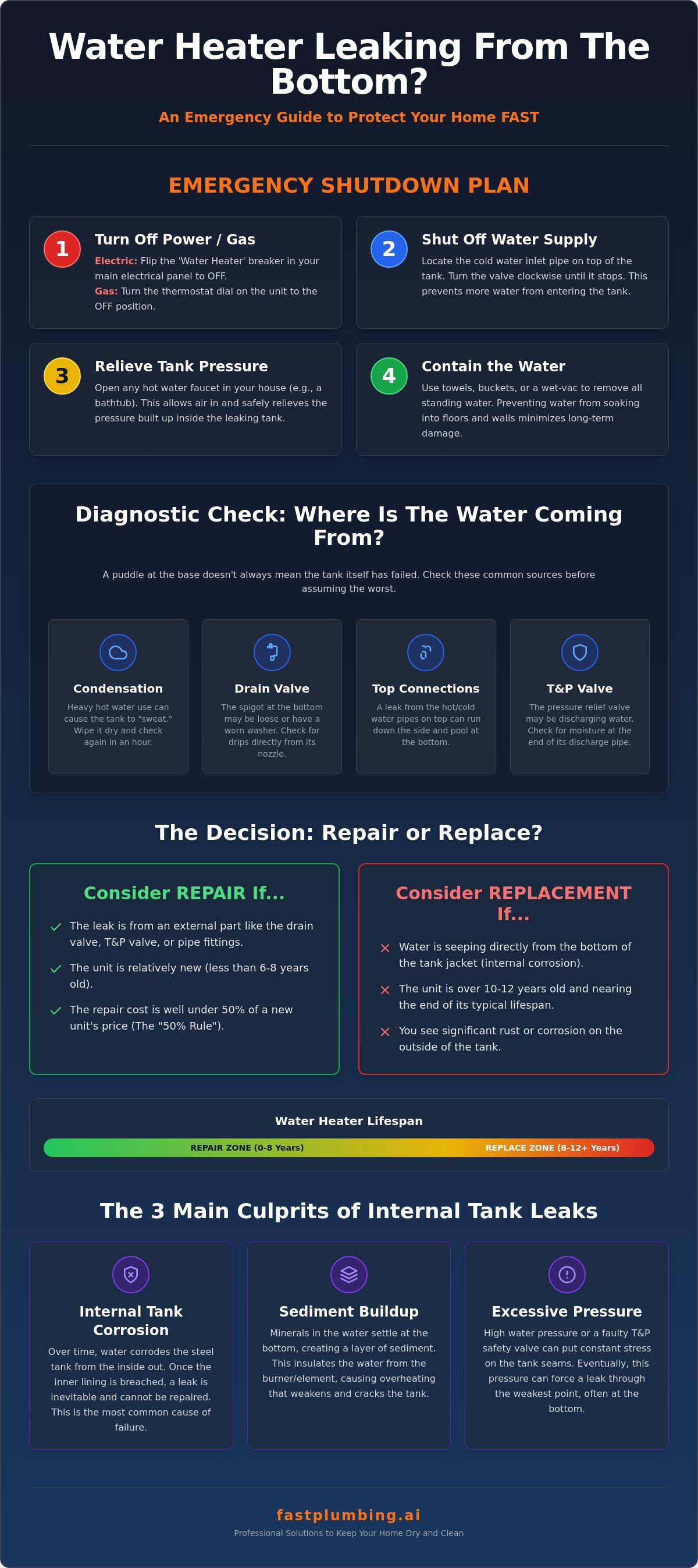
- Immediate Step 1: Kill the power at the breaker for electric units or turn the gas control valve to the OFF position.
- Immediate Step 2: Turn off the cold water supply valve located at the top of the tank to stop new water from entering.
- Immediate Step 3: Open a hot water faucet elsewhere in the house, like a bathtub, to relieve the remaining pressure inside the tank.
- Immediate Step 4: Clear the area and soak up standing water with towels or a wet-vac to prevent permanent structural damage to your floors.
Taking these actions now prevents a minor crisis from becoming a total disaster. Understanding how storage water heaters work helps you realize that the tank is a pressurized vessel. When the bottom leaks, the integrity of that vessel is compromised. Acting FAST is the only way to protect your property while you figure out your next move, right?
Shutting Off Power: Gas vs. Electric Safety
Safety is your top priority. For an electric water heater, locate your main electrical panel and find the breaker labeled "Water Heater." Flip it to the OFF position. If you have a gas unit, look for the thermostat dial on the front of the tank. Turn the dial to the OFF position. Never leave the power or gas on when the tank is leaking. Heating a compromised tank can lead to dangerous pressure spikes or burn out your heating elements, making a repair impossible. We want to keep you safe and keep your costs down.
Isolating the Water Supply
Look at the pipes connected to the top of your tank. You will see a shut-off valve on the cold water intake pipe. A ball valve has a lever that you turn 90 degrees until it's perpendicular to the pipe. A gate valve looks like a small wheel; spin it clockwise until it's tight. If the valve is stuck or covered in green corrosion, don't force it too hard or you might snap the handle. If the valve fails to budge, you must shut off the whole-house water supply at the main meter to stop the leak. Keeping the water off is the only way to guarantee the leaking stops until a pro arrives.
Diagnostic Check: Is the Leak Coming from the Tank or Somewhere Else?
Don't assume your tank is dead just because you see a puddle. Determining a water heater leaking from bottom what to do starts with a simple visual inspection. Sometimes, the water you see at the base didn't actually start there. It might be traveling down from a higher point, or it might not even be a leak at all. Before you commit to a full replacement, perform these quick diagnostic checks to find the real source of the moisture.
- Rule out condensation: If you've had heavy hot water usage during cold weather, your tank might just be "sweating." Wipe the area dry and check back in an hour.
- Check the drain valve: Look at the plastic or brass spigot near the bottom. If it's dripping, it might just be loose or have a failed internal washer.
- Inspect the top connections: Water from a loose cold water inlet or hot water outlet pipe can run down the side of the tank and pool at the bottom, creating a deceptive puddle.
If you've wiped everything dry and the water returns quickly, the issue is likely internal. If you can't find the source, our team specializes in leak detection to identify the culprit FAST. You want to be 100% sure before you spend money on a new unit, right?
Inspecting the Temperature and Pressure (T&P) Valve
The T&P valve is a critical safety component usually located on the top or side of your tank. It's designed to release water if the internal pressure or temperature gets too high. Check the discharge pipe connected to this valve. If you see water dripping from the bottom of that pipe, the valve is either doing its job or it has failed due to mineral buildup. Look for crusty white or green deposits around the valve opening. This is a common sign that the valve needs a quick, professional replacement rather than a whole new tank.
Checking Electric Heating Elements
For those with electric units, the leak might be hiding behind the access panels. Safety first: ensure the power is OFF at the breaker. Remove the side panel and move the insulation aside to inspect the heating element. If you see moisture or "weeping" around the element gasket, the seal has likely perished. Identifying a failed gasket versus a rusted-out tank shell can save you hundreds of dollars. If you see moisture behind the panel, contact Fast Plumbing to solve the issue before the water causes a short circuit and kills the unit entirely.
Why Water Heaters Leak from the Bottom: The 3 Main Culprits
The bottom of your tank is the most common failure point for a reason. It is where gravity pulls every mineral, piece of debris, and drop of corrosive water. When you're trying to figure out a water heater leaking from bottom what to do, understanding the "why" helps you realize that most bottom leaks aren't just bad luck. They are the result of years of internal stress and chemical reactions that finally broke through the steel shell. Here are the three primary reasons your tank has finally given up.
- Anode Rod Failure: Every tank has a "sacrificial" rod designed to rust so the tank doesn't. Once this rod dissolves completely, the water begins eating the steel walls of the tank.
- Thermal Expansion: Your tank expands when it heats up and contracts when it cools. Over a decade, these thousands of cycles fatigue the bottom seams until they eventually hairline crack.
- Corrosive Water: High mineral content or "hard water" acts like sandpaper on the internal glass lining. Once that lining cracks, the steel underneath has no protection.
Most homeowners don't realize their water heater is a ticking clock. If you haven't replaced your anode rod in the last five years, your tank is likely fighting a losing battle against rust right now. It's a simple component, but its failure is the leading cause of catastrophic floods, right?
The "Silent Killer": Internal Tank Rust
Internal rust is often called the silent killer because you won't see it until the puddle appears on your floor. Most modern tanks are lined with a thin layer of glass to protect the steel. However, tiny cracks can form due to age or high water pressure. Once water reaches the steel shell, oxidation begins. If you see a rusty puddle, it almost always means the tank is beyond saving. You can schedule a professional water heater repair diagnostic to confirm, but a rusted-through bottom usually signals the end of the road.
Sediment and the "Popping" Noise Warning
Have you heard a strange popping or rumbling sound coming from your utility closet lately? That is the sound of sediment. Minerals like calcium and magnesium settle at the bottom of the tank, creating a thick layer of "sludge." This sludge acts as an insulator, trapping heat at the bottom. This creates "hot spots" that weaken the metal over time. Not only does this make your unit incredibly inefficient, but it also cooks the bottom of the tank until it fails. Regular flushing can prevent this, but if the leak has already started, the damage is likely permanent. We see this every day; a little maintenance goes a long way in avoiding a 2:00 AM emergency.
The Decision Matrix: Repair or Replace the Leaking Unit?
Deciding whether to sink money into a fix or invest in a new unit is the most stressful part of a water heater leaking from bottom what to do crisis. We use a clear "Decision Matrix" to help you make the right choice without the guesswork. Most traditional tank-style water heaters have a reliable lifespan of 8 to 12 years, according to data from Angi. If your unit is approaching its tenth birthday and leaking from the base, you are likely throwing good money after bad by attempting a major repair. You want a solution that lasts, not a temporary patch that fails next week, right?
The "50% Rule" is our gold standard for homeowners. If a professional repair estimate exceeds half the cost of a brand-new installation, we always recommend a replacement. Modern units are far more energy-efficient than older models. While new Department of Energy efficiency standards for residential units aren't effective until May 6, 2029, today’s models already offer significantly better insulation and lower operating costs than units built a decade ago. Choosing a new unit now can stop the leak and lower your monthly utility bills simultaneously.
When a Simple Repair is the Answer
Not every puddle signifies a total loss. If our diagnostic check reveals that the water is coming from a faulty drain valve or the T&P valve, a simple component swap can solve the problem. These external parts are designed to be replaced. We can also swap out a corroded heating element or a perished gasket on electric models to stop a "weeping" leak. If the leak is actually coming from a loose plumbing connection at the top of the unit, we can tighten or replace the fitting and get you back to normal FAST. These are manageable fixes that don't require a full tank replacement.
Signs You Need an Immediate Replacement
Some leaks are terminal. If you see water seeping directly through the steel jacket or from the bottom seam of the tank, the internal glass lining has failed. There is no safe way to weld or patch a pressurized tank once the shell is compromised. Chronic rust in your hot water is another signal that the tank is disintegrating from the inside out. If your unit has already passed its 12-year warranty period, a bottom leak is a "red alert" that a catastrophic flood is imminent. Don't wait for your basement to fill with water. Schedule a water heater inspection with Fast Plumbing today to get a permanent solution delivered to your door, fast and hassle-free.
Professional Solutions: Get Your Hot Water Back FAST and Hassle-Free
You've followed the emergency steps. You've looked at the damage. Now, you need a permanent fix so you can stop worrying about your floors and get back to your life. When you're facing a water heater leaking from bottom what to do next is simple: bring in a team that values your time as much as you do. We don't just fix pipes; we restore your peace of mind with a process designed for speed and total reliability.
- 24/7 Emergency Service: Plumbing crises don't stick to a 9-to-5 schedule. We arrive to your door - fast and hassle-free, no matter when the leak starts.
- Transparent Pricing: You deserve honesty. We provide clear plumbing repair costs upfront with no hidden fees or "surprise" surcharges.
- The Clean-Up Guarantee: We treat your property with absolute respect. Our technicians "Clean-Up Like It's Their Own," leaving your home spotless.
- Expert Installation: Our licensed pros are experts in every major brand. Whether it's a quick component fix or a full tank replacement, we get it done right the first time.
We know that a leaking water heater creates a high-pressure situation for any homeowner. Our goal is to lower your blood pressure the moment we arrive. You want a pro who shows up on time, works clean, and speaks your language, right?
Why Speed is Our Signature
In an emergency, every second counts. That is why we offer a 1-minute callback guarantee. We don't believe in keeping you waiting while water pools in your basement. Our team is hyper-disciplined and focused on punctuality. We offer same-day replacement options to minimize your family’s downtime. Our "no-nonsense" approach means we skip the fluff and move straight to the solution. We arrive prepared with the right tools and the right expertise to solve your problem ASAP.
Protecting Your Home During the Process
Removing a heavy, water-logged tank can be a messy job, but not when we handle it. We take specific precautions to prevent any further water damage or floor scuffs during the removal of your old unit. Our commitment to regular, clear communication means you'll know exactly what is happening from the moment of dispatch until the job is complete. We take full accountability for our work and your home's safety. Don't let a leak ruin your week. Call Fast Plumbing now for a 1-minute callback and expert water heater service!
Restore Your Home’s Safety and Comfort Today
You've taken the first critical steps to protect your property. By now, you know exactly why that puddle appeared and whether your tank is a candidate for a quick fix or a total replacement. Understanding the right response to a water heater leaking from bottom what to do is the difference between a minor inconvenience and a ruined basement. You don't have to face the next steps alone. You want a resolution that is permanent and professional, right?
Our team is standing by 24/7 to solve your plumbing crisis ASAP. We pride ourselves on a hyper-disciplined approach that respects your time and your home. We offer a 1-Minute Callback Guarantee so you never feel ignored in an emergency. Plus, we promise a level of respect for your property that includes a Clean-Up Like It Is Our Own guarantee. We arrive on time, work fast, and leave your space spotless. Let us handle the heavy lifting while you focus on getting your day back on track.
Get an Emergency Plumber to Your Door - FAST and Hassle-Free
Take a deep breath and let the experts handle the rest. We'll get your hot water back and your home safe today. You're in good hands.
Frequently Asked Questions
Is a water heater leaking from the bottom dangerous?
Yes, a bottom leak is a serious safety hazard that requires immediate attention. It can lead to electrical shorts in electric models or interfere with the gas burner in gas units. Because the tank is a pressurized vessel, a leak at the base suggests the structural integrity is failing. This could lead to a catastrophic tank burst or significant structural damage to your home if not handled FAST.
Can I still shower if my water heater is leaking from the bottom?
You should avoid using the shower until the unit is inspected and repaired. To manage a water heater leaking from bottom what to do steps include shutting off the water and power. This means you will not have a supply of hot water anyway. Attempting to use a compromised tank keeps it under pressure, which could cause the small leak to turn into a major flood while you are in the shower.
How much does it typically cost to fix a water heater leak?
The cost to resolve a leak depends entirely on whether you are replacing a single component or the entire tank. While we provide honest, transparent pricing after a physical inspection, industry data from Angi shows professional repairs generally range from $228 to $1,016. If the internal tank has failed, a full replacement is usually the most cost-effective long-term solution for your home.
Will my homeowners insurance cover a leaking water heater?
Standard homeowners insurance usually covers the damage caused by the leaking water, such as ruined carpet or drywall. However, it rarely covers the cost to repair or replace the water heater itself. Most providers view a leaking tank as a result of wear and tear or lack of maintenance. You should contact your insurance agent ASAP to confirm the specifics of your coverage and start a claim if the damage is widespread.
How long do I have before a small leak becomes a flood?
There is no way to predict exactly when a small drip will become a total tank failure. It could happen in a few days, or the tank could burst completely in the next five minutes. High internal pressure and heat are constantly working against the weakened metal. This unpredictability is why we treat every bottom leak as an emergency that needs to be solved immediately to protect your property.
Can I fix a bottom leak myself without a plumber?
You can potentially fix the issue yourself if the leak is coming from a loose connection or a faulty drain valve. These are external parts that can be tightened or replaced with basic tools. However, if the leak is coming from the tank shell itself, there is no DIY fix. Attempting to patch a pressurized steel tank is dangerous and will not provide a permanent solution for your home.
What is the most common reason for a 10-year-old heater to leak from the base?
Internal corrosion is the primary reason older units fail at the base. By the time a unit is 10 years old, the sacrificial anode rod has likely dissolved. This leaves the steel tank unprotected against the corrosive effects of water and mineral buildup. Once rust eats through the internal lining, a pinhole leak forms at the bottom, which is a clear signal that the unit has reached the end of its life, right?
Should I switch to a tankless water heater if my current tank is leaking?
Switching to a tankless system is an excellent option if you want to avoid the risk of a 50-gallon tank failure in the future. Tankless models can last up to 20 years and provide endless hot water on demand. When you are deciding on a water heater leaking from bottom what to do, consider that tankless units are more compact and energy-efficient. We can help you determine if your home’s gas or electrical lines are ready for the switch.
