![When to Replace a Water Heater: 7 Critical Warning Signs [2026 Guide]](https://getautoseo.com/storage/hero_images/article_1510822_1779771504.jpg)
When to Replace a Water Heater: 7 Critical Warning Signs [2026 Guide]
Would you rather spend ten minutes reading a guide or three days drying out a flooded basement? Most homeowners ignore the small signs of a failing unit until they are standing in two inches of water. Knowing exactly when to replace a water heater is the difference between a planned, stress-free upgrade and an expensive midnight emergency. You want to keep your family comfortable and your home safe, but the confusion over repair costs versus replacement value can feel overwhelming. It is a stressful situation that no one wants to face alone.
We understand that a cold shower is the last thing you need during a busy morning. Our 2026 guide is designed to lower your blood pressure by giving you a clear roadmap to a safe, dry home. You will learn how to identify the 7 critical warning signs of a dying tank before it's too late. We'll show you how a new, high-efficiency unit can slash your energy bills and provide the peace of mind you deserve. From the 50% repair rule to the 12-year lifespan limit, here is how to decide if it's time for a new unit to arrive at your door, FAST and hassle-free.
Key Takeaways
- Identify visible rust and strange popping noises early to stop a catastrophic tank burst before it starts.
- Master the "10-Year Rule" to pinpoint exactly when to replace a water heater so you never have to deal with a cold morning surprise.
- Use the 50% Rule to determine if a repair is a waste of money compared to the long-term savings of a new unit.
- Choose between traditional storage and modern tankless heaters to lower your energy bills and ensure your family's comfort.
- Act FAST to upgrade your home's safety and avoid the high costs of emergency water damage restoration.
Recognizing the Warning Signs of a Failing Water Heater
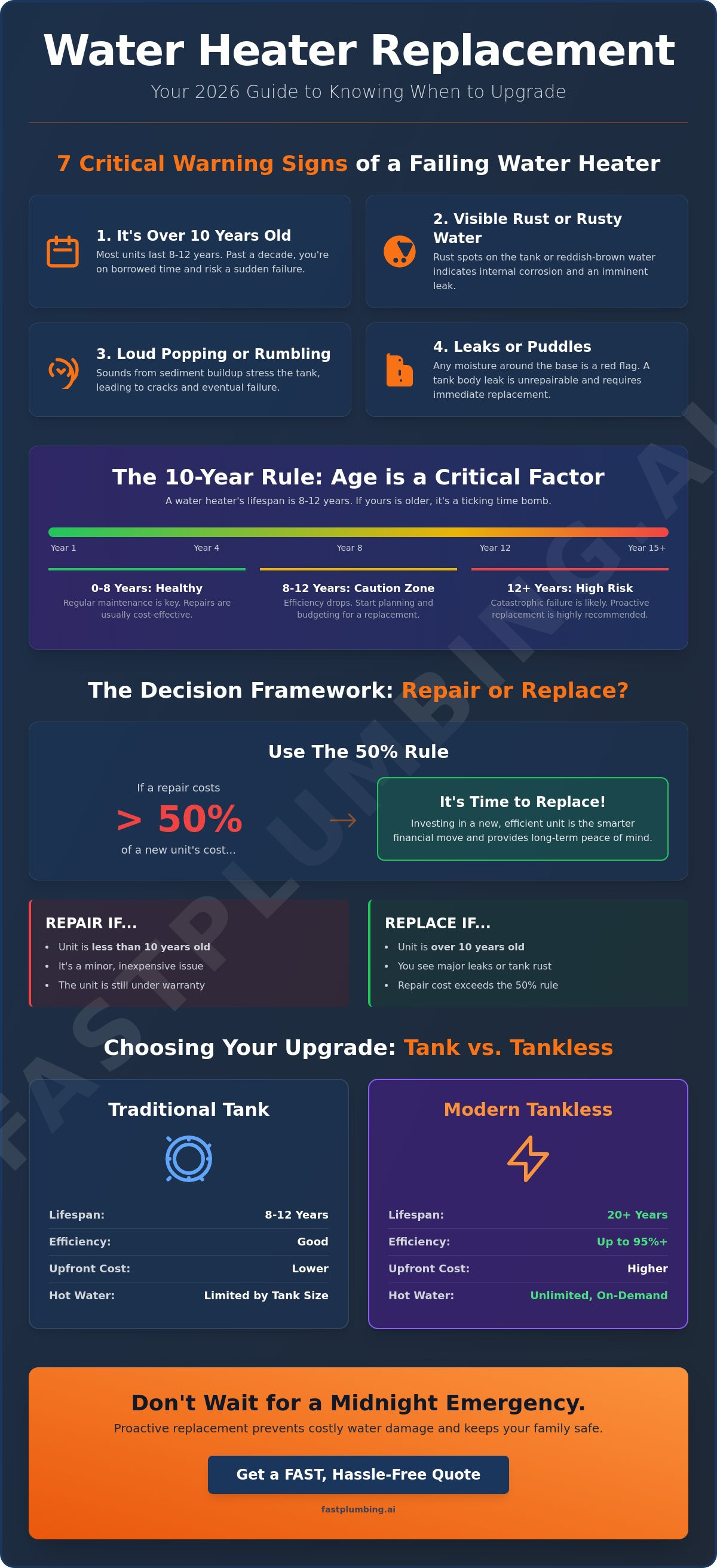
Is your water heater trying to tell you something? Most homeowners ignore the quiet warning signs until they are standing in a flooded garage. Knowing when to replace a water heater starts with a simple visual inspection. You don't need to be a professional plumber to spot the red flags. You just need to know what to look for before a small problem turns into a midnight disaster. If your shower is suddenly turning cold or you hear strange noises from the basement, your unit is likely on its last legs. Start by checking for these four critical indicators:
- Visible rust on the tank exterior or reddish-brown tint in your hot water.
- Loud popping, banging, or rumbling noises during a heating cycle.
- Small puddles or persistent moisture around the base of the unit.
- Water that takes forever to get hot or fluctuates wildly in temperature.
Visible Leaks and Corrosion
Check the base of your unit for moisture immediately. Even a tiny damp spot is a reason for serious concern. While some leaks come from a loose connection or a faulty Temperature and Pressure (T&P) relief valve, others are far more dangerous. Most Conventional storage water heaters eventually succumb to internal corrosion. If you see rust-colored water pooling at the bottom, the tank itself has likely breached. A leak in the tank body is an unrepairable death sentence. You cannot patch a structural failure; you must replace the unit FAST to avoid a catastrophic burst. Keep an eye out for "pitting" on the tank exterior. These look like small, rusty craters. If you see these, the metal is thinning from the inside out and could fail at any moment.
Water Quality and Unusual Noises
Does your water have a strange metallic taste or a cloudy appearance? This is a clear sign of internal decay. As the tank ages, the sacrificial anode rod dissolves. Once that rod is gone, the water begins to eat away at the tank walls. This creates the rust you see in your hot water. You should also listen for a specific popping or rumbling sound. It sounds like popcorn, right? This happens when sediment builds up at the bottom of the tank. The sediment hardens into a thick crust, trapping water underneath. When that water boils, it explodes through the sediment layer. This process creates massive stress on the tank, leading to cracks. Monitoring these sounds will help you decide when to replace a water heater before it fails completely. If your unit is approaching the end of its 8 to 12-year lifespan and making these noises, it is time to act fast and hassle-free to protect your home.
The 10-Year Rule: How Age and Efficiency Dictate Replacement
Most traditional tank heaters are built to last between 8 and 12 years. If your unit has passed the decade mark, you are living on borrowed time. Hard water areas can cut this lifespan even shorter; mineral buildup acts like a slow-moving poison for your tank walls. This age factor is often the most reliable way to decide when to replace a water heater before a disaster strikes. You don't want to wait for a flood to tell you that your time is up. Staying ahead of the clock keeps your home dry and your family safe.
Determining the Age of Your Unit
Don't guess the age of your system. Look at the manufacturer label near the top of the tank. The serial number contains a hidden date code that tells the whole story. Usually, the first two numbers represent the year of manufacture. If that number is "15" or lower, your unit is at least 11 years old in 2026. It is a ticking time bomb. Units of this age are prone to sudden, catastrophic leaks that can ruin your flooring in minutes. If you skipped your annual flushes over the years, the sediment buildup has likely already caused permanent internal damage. This damage makes the metal brittle and ready to snap under pressure.
The ROI of Modern Energy Efficiency
Why keep pouring money into an old, inefficient tank? Modern 2026 units are engineered to meet much stricter energy standards than those built a decade ago. A unit from 2016 operates at a fraction of the efficiency of a new heat pump or tankless model. Water heating accounts for approximately 18% of your home's total energy use; upgrading now can slash your monthly utility bills immediately. New industry trends are pushing toward 95% thermal efficiency for gas models, which is a massive leap over older technology. Repairing a 10-year-old unit is a bad investment. You are just paying to delay the inevitable, right? Choosing a proactive water heater replacement now is the smartest financial move you can make.
Deciding when to replace a water heater involves balancing the age of your current unit against the immediate savings of a new one. In 2026, the gap between old and new technology has never been wider. Newer models heat water faster while using significantly less power. This means you get more hot water for less money every single month. We can get a high-efficiency unit to your door - fast and hassle-free. Don't let an old tank dictate your schedule; take control now before an emergency happens.
Repair vs. Replace: A Decision Framework for Homeowners
Are you tired of patching up a sinking ship? Deciding when to replace a water heater often comes down to simple math. We recommend using the "50% Rule" as your primary guide. If the cost of a single repair is half the price of a brand-new unit, you should stop spending money on the old one. Why pay for a temporary fix when that same money could go toward a modern, reliable system? It is about making a smart investment in your home's future rather than just surviving the next few months.
Frequency is just as important as the price tag. Is this the third time you have seen a plumber this year? Constant breakdowns are a cry for help from a system that is fundamentally worn out. You should also check your warranty status immediately. If the tank is still under a manufacturer guarantee, a repair might be covered. However, if the warranty has expired and the repair bills are mounting, replacement is the only logical path forward. To make an informed choice, you should first understand plumbing repair costs and how flat-rate pricing compares to hourly rates. You want a solution that is permanent and hassle-free, right?
When a Simple Repair is the Answer
Not every problem requires a brand-new tank. If your unit is less than six years old, a targeted fix is often the right move. Replacing a faulty thermocouple or a pilot light assembly is a quick, inexpensive task that can restore your hot water in minutes. Similarly, if you see water dripping from the Temperature and Pressure (T&P) relief valve, we can often swap that part out without replacing the whole system. For electric models, a burnt-out heating element is a common issue that is easily solved. These are minor hurdles, not system-wide failures. We handle these repairs FAST so you can get back to your day without stress.
When Replacement is the Only Logical Choice
There are some red flags that no amount of repair work can fix. A cracked inner liner or structural rust on the tank body are terminal conditions. Once the tank itself is compromised, there is no "patching" it. Multiple component failures occurring at once are another sign that the end is near. If the thermostat, the heating element, and the valve are all failing, the system is telling you it's done. The hidden cost of waiting for a total failure is the risk of a massive flood. A proactive replacement prevents that midnight disaster and ensures your home stays dry. We provide a clean-up like it's our own, ensuring your new installation is seamless and professional.
Why Proactive Replacement Beats an Emergency Flood
Why play Russian roulette with your basement? Deciding when to replace a water heater before it fails is the ultimate move for home safety. If you wait until you hear the sound of rushing water at 2 AM, it's already too late. You are now in crisis mode. Crisis mode means higher costs, limited equipment choices, and a massive mess that requires professional restoration. Proactive replacement puts you back in the driver's seat. It ensures your home stays dry and your family stays comfortable. Fast Plumbing, LLC focuses on a FAST response to solve these issues before they turn into a catastrophe. It's about being a reliable neighbor to your own property, right?
The price of a new heater is a fraction of the cost of full-scale water damage restoration. Think about the difference. A new installation is a controlled, professional process that takes a few hours. A restoration involves industrial fans, dehumidifiers, and potentially tearing out your drywall or flooring. By choosing when to replace a water heater on your own terms, you avoid the stress of "emergency surcharges" often found with midnight calls. You get our best technicians at a time that works for your schedule. We move quickly to solve the problem before the first drop of water hits your floor. This is the core of our FAST approach: speed, reliability, and total peace of mind for every homeowner.
The Hidden Costs of a Burst Tank
A burst tank doesn't just leak; it can dump 150 to 200 liters of water into your home in minutes. This isn't just a puddle. It's a disaster that ruins drywall and warps expensive flooring. Did you know mold can start growing in less than 48 hours? Insurance providers in Australia often reject claims if they see an old, neglected unit was the cause of the damage. You could be on the hook for thousands in restoration costs alone. Beyond the money, the stress of being without hot water for days during a crisis is a nightmare for any family. Acting now prevents that entire scenario from ever happening.
Planned vs. Emergency Installation
When you call Fast Plumbing, LLC before the disaster happens, you get the luxury of choice. You can evaluate the latest high-efficiency models and find the perfect fit for your household's demand. In an emergency, you're often stuck with whatever unit is available on the truck immediately. A planned visit is always more hassle-free and streamlined. We arrive on time, complete the work FAST, and ensure your home remains spotless. We call it "Clean-Up Like It's Our Own," and it's how we show respect for your space. Don't wait for the flood to make the decision for you. Schedule your proactive water heater replacement today and sleep better tonight.
Choosing the Right Upgrade: Tank vs. Tankless Solutions
Once you decide when to replace a water heater, the next step is selecting the technology that fits your home's footprint. You shouldn't settle for the same model you had ten years ago. Look for the Fast Plumbing, LLC seal of quality on all new installs. This is our promise of professional-grade expertise and a military-like focus on your satisfaction. We help you compare modern 2026 standards so you can make a decision that lowers your bills immediately. It is about getting the right solution to your door, fast and hassle-free.
Assess your household’s peak hot water demand to size your unit correctly. A small flat has different needs than a five-bedroom family home, right? Fast Plumbing, LLC provides a professional recommendation to solve your hot water issues FAST. We don't just swap boxes; we ensure the system can handle your morning rush without a drop in temperature. We take the confusion out of the selection process so you can enjoy total peace of mind.
Is a Tankless Water Heater Right for You?
Tankless water heaters are the gold standard for families who never want to see a cold shower again. These units heat water on demand, providing an endless supply for back-to-back showers. They also feature a compact, space-saving design that mounts to the wall, freeing up floor space. While the initial investment is higher for retrofitting gas lines or venting, the long-term energy savings are significant. Tankless models can last up to 20 years, making them a durable choice for those staying in their homes long-term. They are the preferred choice for large households with high hot water demand.
Reliable Storage Tank Options
Don't count out the traditional storage tank just yet. Modern, high-efficiency 160-liter or 250-liter tanks are still a fantastic, cost-effective choice. They are generally faster to install since they often use your existing plumbing setup. If you choose a tank, we focus on the recovery rate to ensure you have hot water ready when you need it. These units are reliable and provide a steady, consistent flow for all your household needs. Ready to make the switch? Get your water heater replaced FAST and hassle-free today!
Secure Your Home and Protect Your Property Today
You shouldn't have to live with the fear of a burst tank or the frustration of a cold shower. By recognizing the critical warning signs like tank decay and sediment noise, you now know exactly when to replace a water heater before a crisis hits. You've seen how age and efficiency dictate your next steps, and why proactive planning beats an emergency flood every time. It is about taking control of your home's safety before a midnight disaster takes control of you.
Fast Plumbing, LLC is here to ensure your transition to a new system is seamless. We bring over 29 years of industry experience to every job, offering a 1-minute callback guarantee and 24/7 emergency service if you need us right now. We treat your property with respect and clean up like it's our own, right? Don't wait for a flood to force your hand. Take action today to ensure your home stays safe and your water stays hot. We are ready to get a new, reliable unit to your door, fast and hassle-free.
Contact Fast Plumbing, LLC for a FAST Water Heater Replacement!
Frequently Asked Questions
How many years does a typical water heater last?
A traditional tank-style water heater typically lasts between 8 and 12 years. Tankless models have a much longer lifespan, often reaching 15 to 20 years or more with proper maintenance. Factors like hard water and how often you flush the sediment can change these numbers. If your unit is in this age range, it is time to consider when to replace a water heater before a leak starts.
Is it worth repairing a 12-year-old water heater?
It is almost never worth repairing a unit that has reached 12 years of age. Most systems are at the very end of their functional life at this point. You should apply the 50% Rule here. If the repair cost is even a small fraction of a new unit, the money is better spent on a replacement. An old tank is prone to sudden failure, so a new install provides much better peace of mind.
What are the signs that a water heater is going to explode or burst?
A leaking tank body or a stuck Temperature and Pressure (T&P) relief valve are the most dangerous signs. If the valve is frozen shut, pressure can build to dangerous levels. You should also watch for extreme, violent popping sounds from heavy sediment buildup. These signs mean the internal structure is under massive stress. We can help you decide when to replace a water heater to avoid these scary situations.
Can I replace a water heater myself, or do I need a pro?
You should always hire a professional for a water heater installation. This job involves working with high-pressure water, gas lines, and venting systems that must meet strict safety codes. A mistake can lead to gas leaks or carbon monoxide issues in your home. Our experts ensure the job is done FAST and hassle-free while keeping your property clean. It is the safest way to protect your investment.
Why is my water heater making a loud popping or knocking noise?
Sediment buildup at the bottom of the tank is the most common cause of these noises. As minerals from hard water settle, they form a hard layer over the burner or heating element. Trapped water underneath that layer boils and pops through the crust. This process makes the tank work harder and eventually causes the metal to crack. Flushing the tank might help, but loud knocking often signals permanent damage.
Will a new water heater really lower my monthly energy bills?
Yes, a new high-efficiency water heater can significantly reduce your utility costs. Water heating accounts for approximately 18% of a typical home's energy consumption. Modern 2026 units use advanced insulation and heating technology to waste far less power than models from a decade ago. Switching to a heat pump or tankless model can offer even deeper savings over the life of the unit.
What should I do immediately if I find my water heater is leaking?
Shut off the water supply valve and the power or gas source immediately. You can usually find the water shut-off on the cold water pipe leading into the top of the tank. For gas units, turn the dial on the thermostat to off. For electric units, flip the breaker in your electrical panel. Once the system is safe, call us to solve the problem ASAP before more damage occurs.
How long does it take for a professional to install a new water heater?
A professional installation typically takes between 2 and 4 hours for a standard tank replacement. If you are switching from a tank to a tankless system, the process may take longer because of required plumbing or gas line upgrades. We pride ourselves on being on time and moving quickly to get your hot water back. We handle everything from the initial visit to the final clean-up.
