
No Hot Water in House? What to Check Before Calling a Professional
Imagine stepping into the shower on a cold morning only to be hit by a blast of icy water that shocks your system. It's a stressful way to start the day, especially when you start worrying about massive repair bills or the confusion of troubleshooting a complex gas or electric system. You just want your warm water back without the headache, right?
Knowing no hot water in house what to check can save you time and potentially a lot of money. We've put together this rapid, step-by-step diagnostic guide to help you identify the problem quickly. Our goal is to help you determine if you can fix the issue yourself with a simple reset or if you need a FAST professional repair to get things back to normal.
We'll walk through a systematic "outside-in" approach. We will check external power and gas sources before blaming the internal hardware. You'll learn the specific differences between electric and gas requirements so you can restore your hot water ASAP. Let's get your home running smoothly again, hassle-free.
Key Takeaways
- Narrow down your crisis instantly by determining if the icy water is a whole-house issue or just isolated to a single fixture.
- Discover how to safely inspect your breaker panel or pilot light to see if a quick reset can get your water hot again ASAP.
- Follow our step-by-step guide on no hot water in house what to check to potentially avoid the cost of an unnecessary service visit.
- Learn to decode tankless error messages and identify the rumbling sounds of sediment buildup before they lead to a total system failure.
- Apply the 50% Rule to make a confident, no-nonsense decision on whether to repair your current unit or invest in a new, high-efficiency system.
Immediate Triage: Identifying the Scope of Your Hot Water Crisis
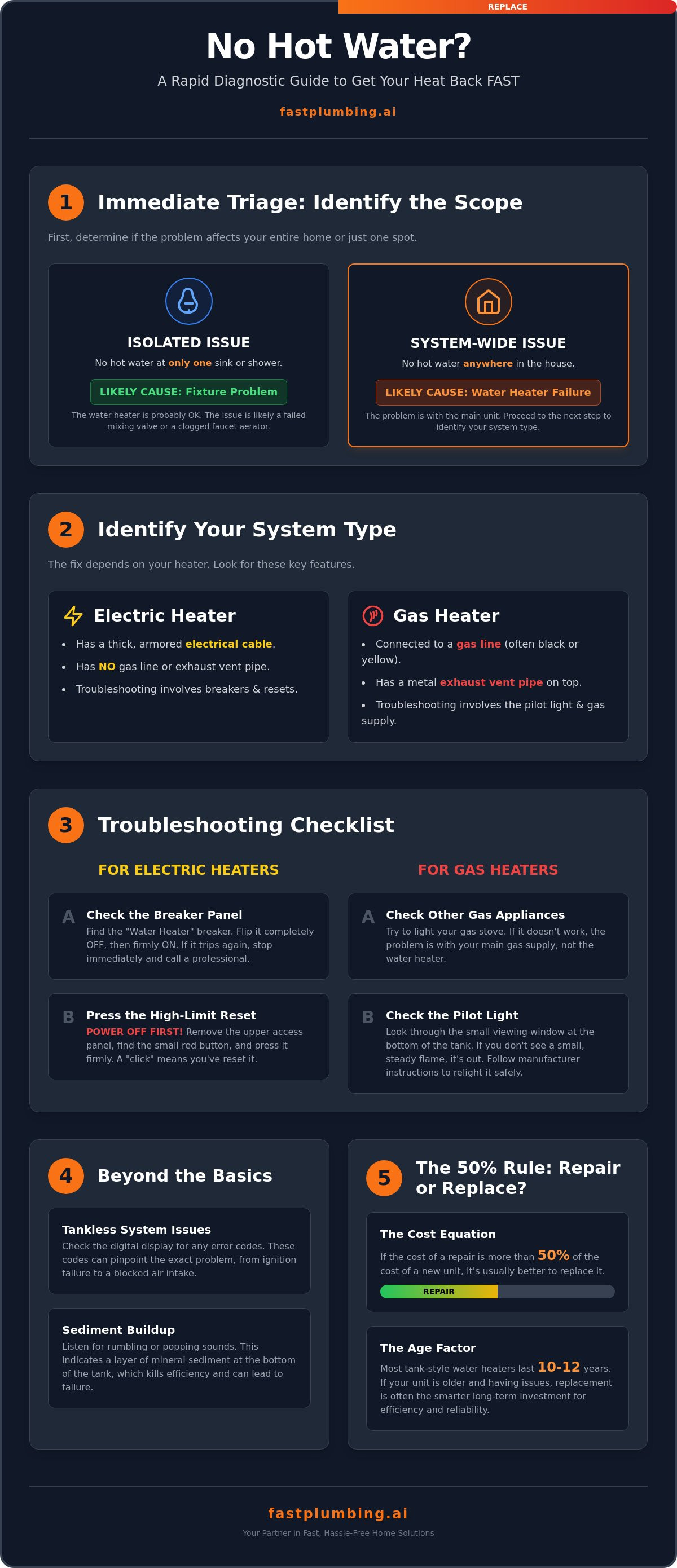
You're standing there in a towel, shivering and frustrated. Stop. Before you grab the phone to call for help, take a deep breath. We need to figure out exactly what's happening. Is the water truly icy? Or is it just "not hot enough"? This distinction is the critical first step in no hot water in house what to check. If every tap in the building is cold, we're looking at a system-wide failure. If it's just one sink or shower, the problem might be much simpler and cheaper to solve than you think.
Is the Problem Isolated or Systemic?
Start by testing multiple faucets across your home. Check the kitchen sink, then move to the guest bath. If the kitchen is steaming but the shower is freezing, your water heater isn't the villain. You likely have a failed mixing valve or a broken shower diverter. These components blend hot and cold water right at the fixture. When they fail, they block the hot water from reaching you even if the tank is full of boiling water. It's a common mistake to replace a perfectly good heater when a small valve was the real culprit. Don't let that happen to you. Check every tap to confirm the scope before moving forward.
Identifying Your System Type Fast
You can't fix what you don't understand. Head to your utility room or garage and look at the unit. A gas water heater will have a physical gas line, usually a yellow or black pipe, and a vent pipe on top. An electric unit will have a heavy, armored electrical cable running into the top or side. To understand the mechanics of these machines, it helps to learn How Water Heaters Work across these different fuel sources. This knowledge helps you speak the same language as a technician if a repair becomes necessary.
Look for the data plate on the side of the tank. This sticker tells you the model, capacity, and age. If you see a small box mounted on the wall instead of a large cylinder, you have a tankless system. Knowing this info is vital. Troubleshooting steps for a gas pilot light are completely different from resetting an electric breaker. Take a photo of this plate now. It will help us solve the problem FAST if you need to call us later.
Finally, check for outside factors. If you have a gas unit, try turning on your gas stove. If it doesn't light, you might have a neighborhood utility outage. The same goes for electric units; check if your lights are flickering or if a storm just rolled through. Identifying these external issues can save you from a service call fee for a problem that isn't even in your house, right? We want to get your home back to normal ASAP and hassle-free. Let's move to the hardware and see what else we can find.
Troubleshooting Electric Water Heaters: Power, Resets, and Elements
If your shower is ice cold and you have an electric system, start at the source. Go straight to your main electrical panel. You are looking for a double-pole breaker labeled "Water Heater." If it sits in the middle position, it's tripped. Flip it completely to "Off" and then back to "On" with a firm click. This simple check is the first rule for no hot water in house what to check. If the breaker trips again immediately, you have a short circuit. Stop there. You need professional help ASAP to prevent a fire hazard.
If the breaker looks fine, you need to verify that power is actually reaching the unit. Use a non-contact voltage tester. Hold it near the point where the armored cable enters the top of the water heater tank. If the tester doesn't glow or beep, the power is being interrupted somewhere between the panel and the heater. Learning how to respond to no hot water involves verifying these external connections before you assume the unit is broken. It's about working smart and moving fast, right?
The Secret "Reset" Button Homeowners Miss
Your water heater has its own internal safety switch. It is called a high-limit switch, and it's designed to shut everything down if the water gets dangerously hot. This red button often trips due to loose wiring or a faulty thermostat. Safety is our priority. Always turn off the power at the main breaker before you touch the unit. Remove the upper access panel on the side of the tank and peel back the insulation. You will see a small red button. Press it firmly. If you feel a distinct "click," you just solved your crisis. Replace the cover and turn the power back on. If it trips again, you likely have a grounding issue that requires a professional eye.
Heating Element Failure Symptoms
Sometimes you don't lose all your heat at once. You might notice the water stays lukewarm or that your hot water supply runs out in just a few minutes. These are classic signs of a burnt-out heating element. Electric heaters usually have two. If the upper element fails, the water stays cold. If the lower element fails, you only get a tiny bit of hot water before it turns icy. Replacing these elements requires draining the tank and handling high-voltage components. If that sounds like too much, it is time to look into professional water heater repair. We can get a technician to your door fast and hassle-free. If you want a quick resolution, contact our team now to get your hot water restored today.
Diagnosing Gas Water Heater Issues: Pilot Lights and Supply Lines
Gas systems are known for their efficiency, but they introduce a unique set of safety concerns. When you have no hot water in house what to check first is your gas supply. Start at the base of the unit. Look for the gas shut-off valve. If the handle is perpendicular to the pipe, the gas is off. Turn it so it sits parallel to the line to restore the flow. If you've recently had utility work in your area, the line might have been shut off at the meter. Check your other gas appliances, like a stove or fireplace, to confirm the house has fuel. If nothing works, the issue is with the utility provider, not your heater.
Relighting the Pilot Light Safely
Before you even touch the control knob, perform a "Smell Test." If you detect a strong scent of rotten eggs, stop immediately. This is a sign of a leak. Open your windows, get everyone out of the house, and call for help. Safety is non-negotiable. If you don't smell gas, look through the small viewing pane at the bottom of the tank. If you see a small blue flame, your pilot is lit. If it's dark, you need to relight it. Turn the knob to "Pilot," press it down firmly, and click the igniter button. You must hold that knob down for at least 60 seconds. This gives the thermocouple enough time to heat up and tell the system it's safe to keep the gas flowing. It's a simple process that solves the problem FAST, right?
When the Pilot Won’t Stay Lit
Does the flame vanish the moment you release the knob? This usually points to a faulty thermocouple. This small copper rod is a safety sensor. If it's covered in soot or slightly out of alignment, it won't detect the heat. It shuts the gas off to prevent a dangerous buildup. You can try gently cleaning it with a piece of fine sandpaper once it's cool. However, if the rod is burnt or the gas control valve itself has failed, DIY fixes are over. Dealing with combustible fuel requires a high level of precision. This is when a gas line repair expert should take over. We handle these complex component failures to keep your home safe and your showers hot. We pride ourselves on good communication and a clean-up that leaves your home exactly as we found it. Let's get this solved ASAP and hassle-free.
Don't forget to glance at the vent hood at the top of the tank. If debris or a bird's nest blocks the exhaust, the safety sensors will trip and kill the pilot. A clear vent is essential for both performance and your family's safety. If the vent is clear and the pilot still won't hold, the internal gas valve is likely the culprit. We can diagnose this in minutes and provide a reliable solution on the spot. We treat your property as if it were our own, ensuring a safe and professional outcome every time.
Beyond the Basics: Tankless Systems, Sediment, and Hidden Leaks
Sometimes the problem isn't a simple tripped breaker or a blown-out pilot light. If you've followed the basic steps and still have no hot water in house what to check next involves looking deeper into the mechanical health of your system. Modern heaters, especially high-efficiency tankless models, are complex machines. They often require a more technical "inside-out" diagnostic approach to find the root cause of the cold. We want to help you identify these hidden issues before they turn into a total system replacement, right?
Tankless Specific Troubleshooting
Tankless units are smart. Most models feature a digital display that flashes specific error codes when something goes wrong. Don't ignore these numbers. They are your roadmap to a fast resolution. A common culprit for tankless failure is a blocked air intake or exhaust vent. Birds or rodents often build nests in these pipes, which starves the unit of oxygen and triggers a safety shutdown. You should also check the cold water inlet filter. If this screen is clogged with debris, the unit won't detect enough flow to ignite the burners. Remember, these systems need annual descaling to remove mineral buildup. Without it, you'll face frequent "no hot water" errors that get worse over time. If your screen is dark or showing a code you don't recognize, call us for a rapid diagnostic check to get your system back online ASAP.
Sediment and Internal Component Failures
For traditional tank heaters, your ears are your best diagnostic tool. Do you hear a rumbling, popping, or banging sound coming from the unit? That's the sound of heavy sediment buildup. Over time, minerals settle at the bottom of the tank and harden. This layer acts as an insulator. It forces the burner to work twice as hard to heat the water through the "rock" at the bottom. This doesn't just waste energy; it eventually causes the tank to overheat and fail. If you have plenty of water but it's only lukewarm, you might have a broken dip tube. This internal plastic pipe is supposed to direct cold water to the bottom of the tank. If it breaks, cold water stays at the top and mixes with your hot water, sending a tepid stream to your shower.
Finally, check the T&P (Temperature and Pressure) valve on the side of the tank. If you see active leaking or a steady drip, your system is under too much stress. Hidden leaks are another silent killer of hot water. If your heater is working but the water never reaches the tap, it might be escaping through a slab leak or a burst pipe in the wall. This is a serious situation that requires professional leak detection services to prevent property damage. We use advanced technology to find these threats without tearing up your home. We treat your property like our own, ensuring a clean-up that's as fast and hassle-free as the repair itself.
Repair vs. Replace: Making the FAST Decision for Your Home
You have gone through the diagnostic steps for no hot water in house what to check. Now you face a critical choice. Should you spend money on a repair or invest in a brand new unit? We use a simple, no-nonsense "50% Rule" to help you decide. If the cost of the repair exceeds half the value of a new system, it is time to replace it. Throwing money at an old, failing tank is a gamble you don't want to take, right? We want to solve your problem for good, not just for today.
Consider the age of your system. Most traditional water heaters have a lifespan of 8 to 12 years. If your unit is in the double digits, internal corrosion is likely already eating away at the tank. A repair might fix a single component, but it won't stop the next leak from happening. Modern systems are significantly more energy-efficient than models from a decade ago. Upgrading can lower your monthly utility bills and provide a more reliable stream of hot water. Moving fast on a replacement often prevents the secondary water damage that comes when an old tank finally breaches. We help you make this transition hassle-free and on-time.
When to Call an Emergency Plumber
Some situations require immediate professional intervention. If you see a pool of water forming at the base of your heater, you likely have a tank breach. This is a ticking time bomb for your flooring and drywall. Smelling gas or scorched electrical wiring is another major red flag. Shut off the fuel source and call us ASAP. If your water heater failure is accompanied by backups in your tubs or sinks, you might have a deeper issue. You may need a professional drain cleaning if sewage is involved in the backup. We handle these complex crises with military-like focus and speed.
The Fast Plumbing Advantage
We know that a house without hot water is a house in crisis. That is why we offer a 1-minute callback guarantee. When you reach out, we respond instantly. Our team arrives ready to work, and we provide transparent plumbing repair costs upfront. You will never be surprised by hidden fees or confusing jargon. We also take pride in our "Clean-Up Like It's Their Own" promise. We treat your property with extreme respect and leave your home better than we found it. You get professional expertise and a hassle-free experience every single time. Let's get your hot water back to your door fast and reliably.
Restore Your Comfort and Confidence Today
Dealing with an icy shower is a major disruption. By knowing no hot water in house what to check, you have narrowed down the problem and ruled out simple fixes like a tripped breaker or a blown pilot light. You now understand the 50% Rule and whether your system is nearing the end of its 12 year lifespan. Whether you need a quick descaling for a tankless unit or a full replacement for a leaking tank, you are ready to make a smart, informed decision.
You want your home back to normal without the mess or the wait, right? Our Licensed and Insured Master Plumbers provide 24/7 Emergency Service to handle any crisis ASAP. We offer a 1-Minute Callback Guarantee because we value your time. Get your hot water back FAST; call our experts for same-day service! We solve the problem and clean up like it is our own home. You are just one step away from a warm, hassle-free home. Let's get it done today.
Frequently Asked Questions
Is it dangerous if I have no hot water but the cold water works?
A loss of hot water is usually not an immediate danger, but it depends on the cause. If you smell rotten eggs or see scorched wires near your tank, you are in a high-risk situation. Turn off the fuel source and the main breaker immediately. For most homes, it simply means a component has failed. However, a total loss of hot water is a crisis for your comfort. We can solve this ASAP and keep your family safe.
How much does it typically cost to fix a water heater pilot light?
Repair costs for a pilot light depend on whether you need a simple cleaning or a new thermocouple. We provide transparent, flat-rate pricing upfront so you are never surprised by the final bill. A simple relight is a quick job, but a broken gas valve requires a more involved repair. Call us for a specific diagnostic check to get your system running today. We treat your home with respect and ensure a hassle-free experience.
Can I replace a water heater heating element myself?
You can replace an element if you are comfortable handling high-voltage electricity and plumbing. The process requires turning off the breaker, draining the tank, and using a specific element wrench. One small mistake can lead to a dangerous short circuit or a major leak. If you want a reliable solution, let a professional handle these complex components. We get the job done fast and leave your utility room cleaner than we found it.
What should I do if my water heater is leaking from the bottom?
Turn off the water supply valve and the power or gas immediately. A leak from the bottom of the tank usually signals an internal breach. This is a serious issue that often requires a full replacement of the unit. Do not wait for the tank to burst and flood your home. We provide rapid diagnostics to see if a repair is possible or if you need a new, high-efficiency system to protect your property.
Why does my hot water run out so much faster than it used to?
Sediment buildup is the most common reason for a shrinking hot water supply. Over time, minerals settle at the bottom and displace the water in your tank. This leaves less room for actual hot water. A broken dip tube can also cause this by mixing cold water into the hot outlet. This is a key part of no hot water in house what to check when your showers are getting shorter every day.
How long does a standard storage tank water heater last?
A standard storage tank typically lasts between 8 and 12 years. Factors like local water hardness and maintenance frequency play a huge role in this lifespan. If your unit is over a decade old, you are likely facing internal corrosion. Modern units are much more efficient and reliable. We can help you decide if a repair is worth the investment or if a new system is the smarter, more cost-effective choice for your home.
Does a tripped breaker mean I need a new water heater?
A tripped breaker does not always mean you need a new unit. It often happens due to a temporary power surge or a minor electrical overload. However, if it trips repeatedly, you likely have a grounded element or a short circuit. This requires a professional inspection to ensure your home stays safe from fire hazards. Reset it once; if it flips again, call us for a fast repair to solve the underlying electrical issue.
What are the most common error codes for tankless water heaters?
Ignition failure and venting obstructions are the most frequent codes on tankless displays. You might see messages indicating "no flame" or "blocked exhaust pipes." Scale buildup from hard water also triggers specific maintenance alerts that can shut the system down. Check your manual for the exact code meaning. We can decode these messages and provide a reliable fix to get your endless hot water back to your door today, fast and hassle-free.
